
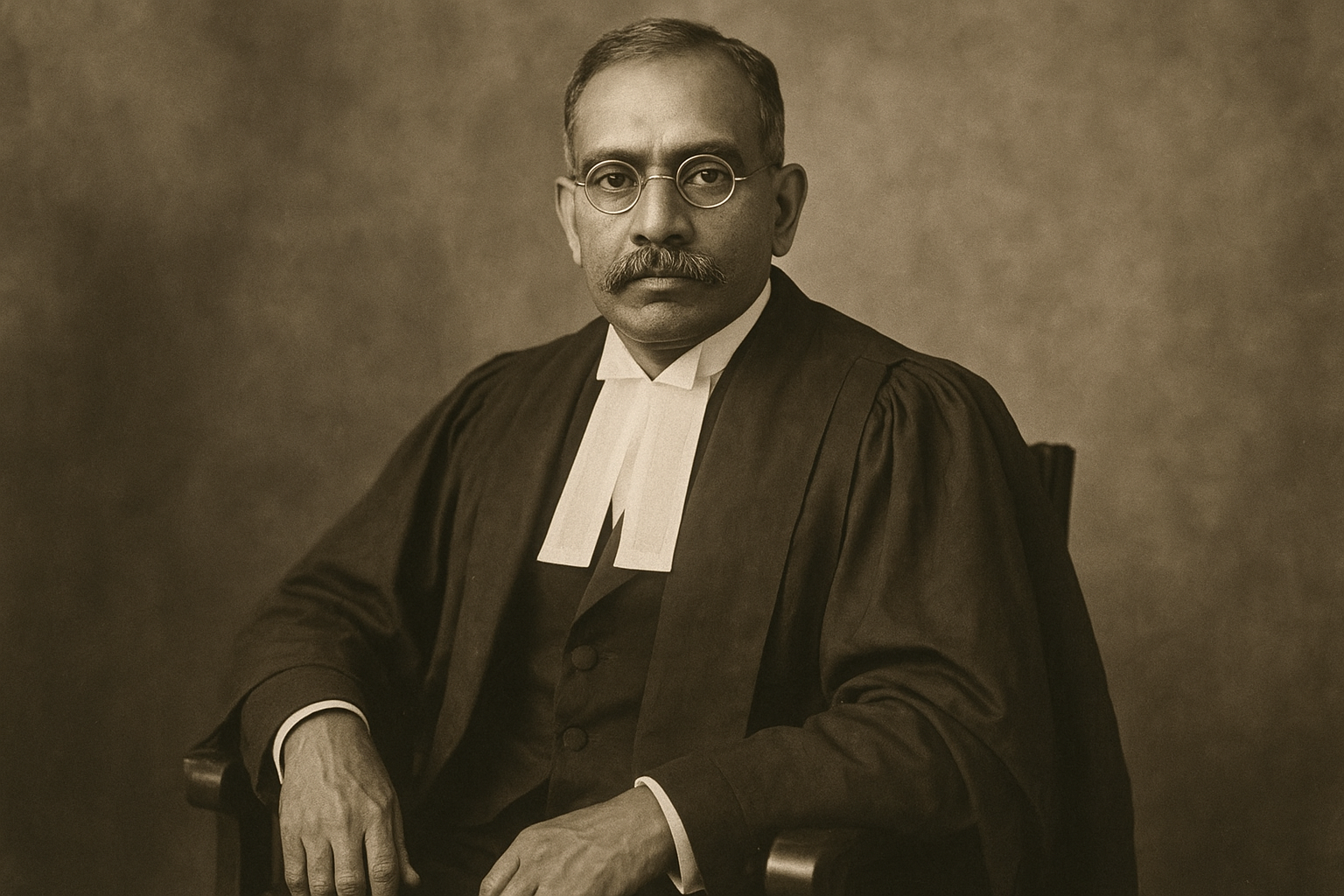
 There are men who fight revolutions from outside the system. They march on the streets, raise slogans, and take on the empire head on. And then, there are those who sit inside the empire’s highest offices yet dare to raise their voice against injustice.
Sir Chettur Sankaran Nair belonged to the latter kind. A lawyer, a judge, a statesman but above all, a man whose conscience refused to bend before the British Empire. His life is not as widely told as that of Tilak, Gandhi, or Nehru. Yet, in India’s freedom struggle, his stand after the Jallianwala Bagh massacre shines like a flame. It reminds us that sometimes, a single resignation can shake the foundations of an empire more than a thousand speeches.
Sankaran Nair was born in 1857, the same year India rose with its first revolt against colonial rule. Though the rebellion was crushed, it left behind a memory of defiance that hung over his generation like an unspoken duty.
Growing up in the Madras Presidency, Nair’s early education was shaped by both Indian traditions and Western schooling. Bright and disciplined, he soon found his way to the law a profession that gave Indians a rare weapon. In the courtroom, words could strike harder than swords, and logic could sometimes force the rulers to bow down.
Nair quickly rose as one of the sharpest advocates of his time. His arguments were clear, his sense of justice was unwavering, and his integrity beyond doubt. Unlike many who treated law merely as a career, Nair treated it as a responsibility. For him, the courtroom was not a place to earn wealth or prestige; it was a place to hold rulers accountable, to prove that even within the empire’s own legal framework, fairness could still be demanded.
His brilliance did not go unnoticed as he was elevated as a judge of the Madras High Court. For an Indian in the late 19th century, this was no small achievement. The British rarely entrusted such positions of authority to Indians, and when they did, it was in expectation of loyalty.
But Nair was not content to be a silent cog in the colonial machine. As a judge, he earned a reputation for independence. He applied the law fairly, without fear or favor. He was not afraid to speak when conscience demanded. His presence on the bench sent powerful message that Indians could rise to the highest standards of legal reasoning, and that justice was not the monopoly of the rulers.
Beyond the courtroom, Nair’s interests grew toward public life. He believed law and politics were deeply connected, and that lawyers had a duty to society beyond their chambers. This conviction drew him into the Indian National Congress, the forum that was slowly transforming into the voice of India’s political awareness.
By 1897, Nair’s reputation earned him the chance to preside over the annual session of the Indian National Congress. The Congress of those years was moderate, focused on petitions and appeals to the Crown but even within that space, his leadership showed how deeply lawyers were shaping India’s nationalist thought.
Nair’s speeches reflected both intellect and balance. He did not indulge in fiery rhetoric, but his words carried weight. He could point out injustice without shouting, and demand fairness and this made him respected even by those who disagreed.
His reputation for fairness soon led to an extraordinary invitation. He was asked to serve on the Viceroy’s Executive Council, the highest advisory body to the British government in India. For an Indian, this was both an honor and also a test. It meant sitting in the same room where policies were drafted, where orders affecting millions were signed.
For some, such a position meant for silent compliance but for Sankaran Nair, it meant an opportunity to confront the empire not from the streets, but from inside its most guarded chambers.
Then came April 13th,1919 the day that changed everything.
In Amritsar’s Jallianwala Bagh, thousands had gathered peacefully to protest the repressive Rowlatt Acts. Families came together in what was supposed to be a meeting, not a mutiny. The garden was enclosed on all sides, with only one narrow exit. When General Reginald Dyer and his troops marched in, they blocked the gates and opened fire without warning.
Men, women, children all trapped. Bullets rained down until ammunition ran out. When it ended, the ground was soaked with blood. The dead and wounded were left where they fell.
The massacre sent shockwaves across India but in official British circles, Dyer’s action was praised. Some British voices called him a savior who had saved Punjab from rebellion.
Sankaran Nair could not accept this.
Sitting on the Viceroy’s Council, he watched as men in power sought to justify the killing of innocents. To remain silent was to be complicit. To remain seated was to bow. So he did a thing that shook the Empire’s pride: he resigned.
His resignation was more than a personal protest; it was an earthquake. A man who had risen to one of the highest positions available to Indians under the Raj had walked out in outrage.
For ordinary Indians, it was proof that conscience was still alive, even in the empire’s own corridors of power. It told them that not every Indian official would be silent. It showed that morality could still roar louder than the empire’s guns.
The British were rattled. They expected Indians in high office to remain loyal. Instead, Sankaran Nair’s act exposed their brutality before the world. His protest became part of the collective memory of Jallianwala Bagh not just the massacre itself, but also the voices that rose against it.
But Sankaran Nair did not stop at resignation. He believed the truth had to be written down, recorded, and exposed for history.
In 1922, he published Gandhi and Anarchy. The book was complex. On one hand, it criticized Mahatma Gandhi’s method of non-cooperation, fearing it could lead to disorder and on the other, it laid the violent hypocrisy of British rule, especially their defense in the matter of Jallianwala Bagh.
The book stirred anger in official circles. British authorities accused him of libel for his statements about their actions during the massacre. A case was filed against him in London.
The scene was dramatic: an Indian statesman, once their council member, now standing in a British courtroom, challenging the very empire that he had once served. For Indians, this was not just a trial of Sankaran Nair, but of the moral legitimacy of British rule.
The verdict was legally complex, leaning in favor of the British. But politically, Sankaran Nair had already won. He had dragged the massacre into international discussion. He had forced the empire to defend its brutality in the open. He had shown that one man’s pen could compel an empire to stand trial before the world.
What made Nair remarkable was not blind nationalism, but his independence. He admired the British legal system’s structure but condemned its misuse. He opposed Gandhi’s mass agitation, yet he never compromised in condemning British violence.
This independence made him difficult to classify. Moderates thought he was too bold. Radicals thought he was too cautious. But his refusal to fit into boxes was his strength. He proved that there was more than one way to fight for freedom.
Through all his roles lawyer, judge, council member, author, one principle that tied his life together is justice before power.
Sankaran Nair passed away in 1934, at the age of 77. By then, India’s freedom movement had gathered unstoppable force. The memory of Jallianwala Bagh remained raw, and his principled resignation was etched in the nation’s conscience.
He is not remembered with the same fervor as Gandhi or Nehru. His name is not shouted in slogans. But history holds him as the rebel judge, the man who walked out of the Viceroy’s Council, who stood in London to hold the empire accountable, and who proved that silence in the face of injustice was never an option.
As we close this chapter of our journey through the lawyers of India’s freedom struggle, we see how different their paths were. Tilak roared like a lion, stirring masses into action. Sankaran Nair stood as a judge, calm yet unyielding, letting his conscience speak where others fell silent.
Both, in their own ways, carried forward the fight for India’s dignity.
And in the next step of our journey, we will enter yet another courtroom, where another lawyer took on the empire in his own style. Stay with us because the story of India’s lawyers in the freedom struggle is far from over.