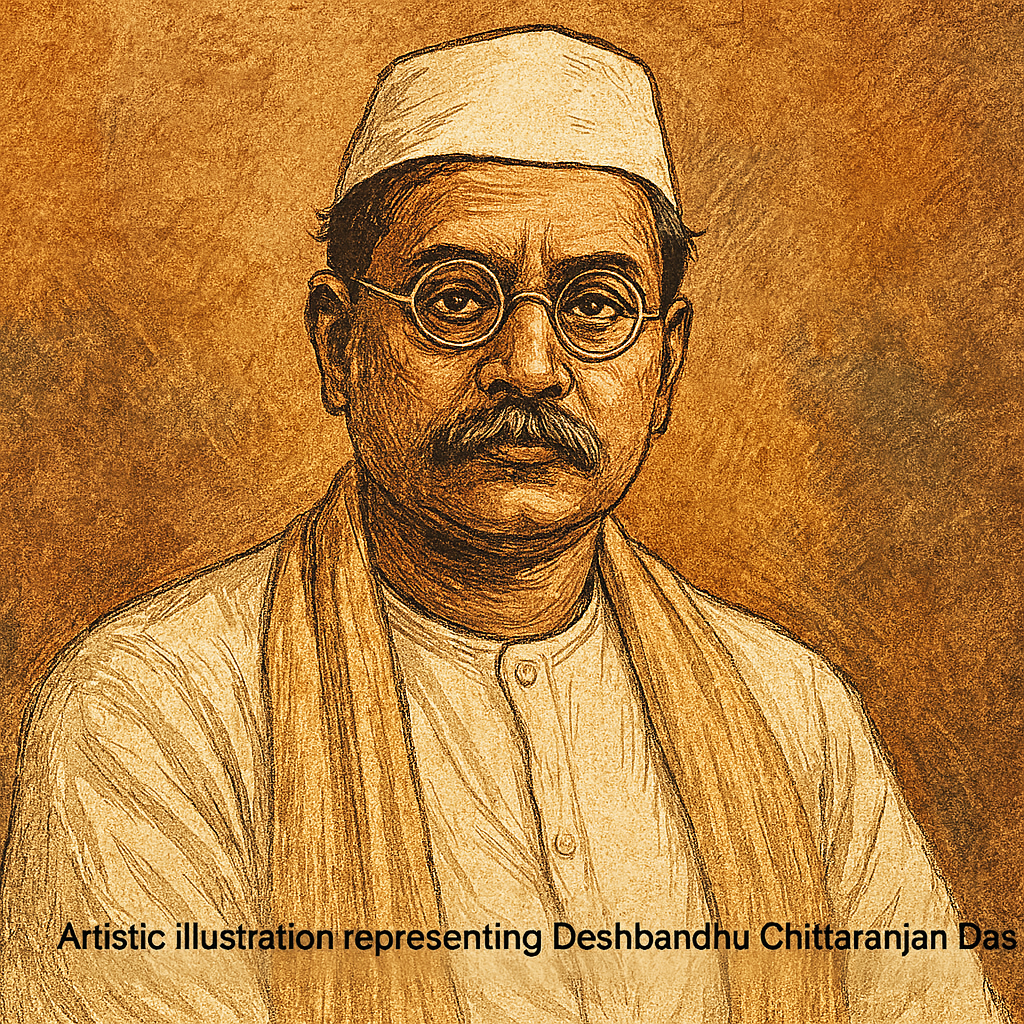
There are lawyers who fight for their clients.
And then there are those who fight for their country.
Chittaranjan Das known to many as Desh Bandhu, the Friend of the Nation belonged to the second kind. His courtroom was a stage for history. His words did not just plead they inspired.
If Tilak was the lion who roared, and Sankaran Nair the judge who stood in conscience, then C. R. Das was the voice that turned a trial into a revolution.
He was born in 1870, in Bikrampur, Bengal then part of the British Empire, now in Bangladesh. His home was filled with books, debate, and purpose. His father, Bhuban Mohan Das, was a respected lawyer, his uncle Durga Mohan Das, a reformer who challenged social evils. It was in that home of ideas that he first learned the power of reason, a power that would one day turn against the Empire itself.
In the lecture halls of Presidency College, Calcutta, he learned ideas of liberty and justice. But to understand power, he had to see its source. So, like many young Indians of his time, he sailed to London. There, he studied law, and perhaps something deeper, the cold logic of empire, and the subtle injustice wrapped in its politeness.
In 1892, he was called to the Bar.
He returned home not just with a degree, but with a fire.
At the Calcutta High Court, Das built a reputation quickly. He didn’t thunder; he reasoned, he didn’t intimidate; he illuminated. Judges leaned in when he spoke. Clients trusted him because he never treated law as business it was a service. Even in success, doubts creeped in as how could justice be given in a court that bowed to the Crown?
The Partition of Bengal (1905) tore the land and its people apart. Petitions were ignored, speeches went unheard and the youth turned restless. Secret societies were born, whispering of bombs and rebellion. The air was filled with anger and fear.
Then came 1908. A failed bomb attack on a British official led to mass arrests. Among those charged with sedition was Aurobindo Ghosh who was a poet, philosopher, and nationalist thinker.
The British built their case on suspicion, and the press painted the accused as terrorists. The message was clear: defiance would not be tolerated.
And into this storm walked C. R. Das.
For months, the Alipore Sessions Court was more than a courtroom it was a battlefield. The prosecution thundered and the empire wanted blood.
In that tense courtroom, Das stood tall, his eyes were not on the jury, but on the pages of history yet to be written.
He told the court that Aurobindo Ghosh was no criminal, he was a visionary, a man who dreamt of a free India. The evidence, Das argued, was smoke, not fire. “Suspicion,” he said, “is not proof.”
Those words echoed far beyond Alipore.
After a long, weary trial, Aurobindo was acquitted in 1909. In that moment, two legends were born Aurobindo Ghosh, the mystic of Pondicherry, and C. R. Das, the lawyer who had defended not just a man, but a movement.
The trial made him a hero. The robe of the barrister had become the armor of a patriot.
That day changed him forever. Law had shown its strength as it was not just to punish, but to protect. He entered the Indian National Congress, bringing with him a lawyer’s logic and a patriot’s heart, qualities that soon made him a leader.
He was a man of faith, faith in reason, in unity, in law used rightly. He believed freedom could not be born of hatred, but of justice.
By 1920, the freedom struggle was shifting. Mahatma Gandhi called for Non-Cooperation, boycott of schools, courts, councils. Das supported the spirit but questioned the strategy. Should Indians abandon every institution or enter them, to expose the empire from within?
He chose the second path.
At the Calcutta Congress of 1920, Das’s speech stirred deep emotion. He pledged to align his own legal practice with the national movement, signaling that the fight for freedom must reach even the courtroom.
Then, leading by example, he walked away from one of the most successful practices in Bengal. The man who could have earned wealth and comfort chose poverty and struggle.
From that day, he was no longer Chittaranjan Das, he was Deshbandhu, the Friend of the Nation.
When Gandhi suspended Non-Cooperation after the Chauri Chaura incident, Das believed the movement couldn’t lose momentum. With Motilal Nehru, he formed the Swaraj Party in 1923.
Their plan was bold but simple: fight elections, enter councils, and wreck the system from within. It was a lawyer’s move masterful, constitutional, yet subversive.
The Swarajists became the voice of defiance inside the very chambers built to silence them. They blocked unjust laws, challenged budgets, and forced the Raj to face its own contradictions.
Das himself became the first Mayor of Calcutta (1924). He brought reforms, built schools, improved sanitation showing that Indians could govern themselves better than their rulers.
Among the young who followed him was a fiery graduate from Cambridge Subhas Chandra Bose. Das saw in Bose not just passion but promise. He taught him strategy, restraint, and the art of turning idealism into action.
To Bose, Das was more than a leader; he was a political guru. And through Bose, his fire would burn long after he was gone.
Das dreamed of Swaraj built on harmony, Hindu and Muslim standing shoulder to shoulder, labor and landlord working together for justice. He warned that a divided freedom would be no freedom at all.
By 1924, illness crept in. His body weakened, but his voice remained strong. From his sickbed in Darjeeling, he dictated letters, drafted plans, mentored colleagues.
To those who urged rest, he replied,
“If life is short, let it burn bright.”
And so it did.
On 16 June 1925, Deshbandhu took his final breath, his life’s flame spent in service of the nation.
He was just 55.
Calcutta stood still.
Thousands joined the funeral procession Hindu, Muslim, Sikh, shoulder to shoulder. Tributes poured in from every corner of the country. Gandhi called him “a patriot of the rarest courage.”
The friend of the nation had become a memory, but not a silence.
C. R. Das left no monuments of marble, but something stronger a legacy of conscience.
He showed that law could be used to defend liberty, not just maintain order.
He proved that councils could become arenas of protest, not symbols of obedience.
He mentored those who would carry the torch from Subhas Chandra Bose to the Swarajists who kept the flame alive.
Above all, he reminded us that true justice demands courage, not authority.
As we close this chapter, we remember the voice that once echoed through colonial courts not pleading for mercy, but demanding justice.
Tilak had roared, Nair had stood, and Das had reasoned, each in their way turning law into a weapon of freedom.
And now, as we turn the page, we move from Bengal’s bar to another courtroom, another lawyer, another fight. Because freedom was not won in a day, or by one voice. It was a chorus of lions, rebels, and friends of the nation.
Stay with us.
The story is far from over.