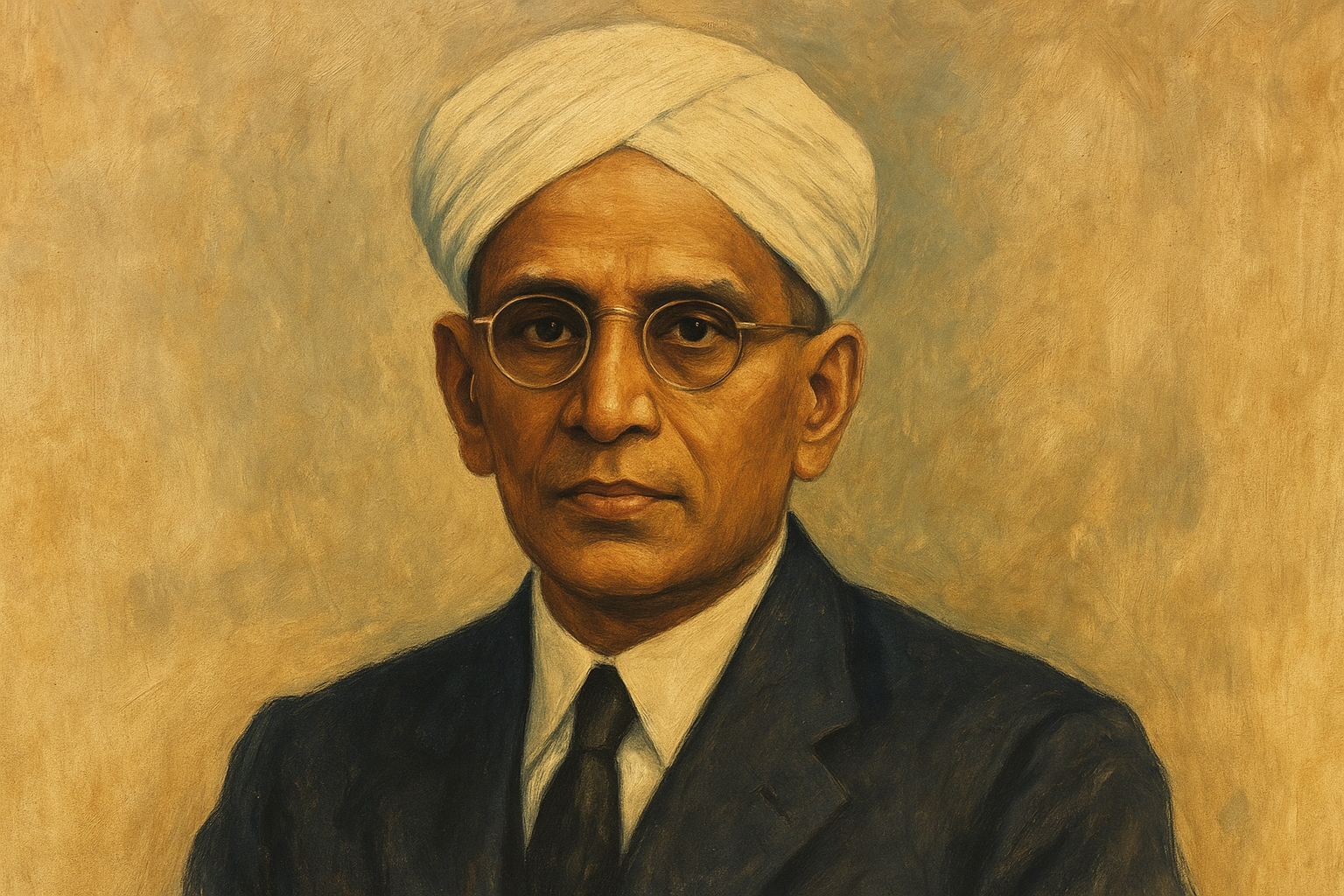
When freedom finally came to India, it did not arrive in silence. It came with arguments, debates, and the sound of minds building a new world through words. In the halls of the Constituent Assembly, where the future of the nation was being shaped, one voice stood out not loud, but calm, deliberate, and brilliant. It belonged to Sir Alladi Krishnaswamy Ayyar, one of the finest legal minds India has ever produced.
He was not a man of slogans or street protests. He was a craftsman of law, a thinker who helped translate freedom into a functioning democracy. His pen, as much as any leader’s courage, laid the foundation of the Republic.
Alladi Krishnaswamy Ayyar was born on 14 May 1883 in Pudur Village, near Tirupati, in what was then the Madras Presidency. He lost his father early, and yes life was hard but it had only made him stronger. He graduated from Madras Christian College, one of the most reputed institutions in South India, where his intellect quickly drew attention. Later, he completed his Bachelor of Law from the Madras Law College. His journey from a village boy to one of India’s leading lawyers showed what Indian talent could achieve despite oppression.
When Alladi began his practice at the Madras High Court, the legal profession was still dominated by British barristers. Indians, however skilled, often faced subtle discrimination. But Alladi’s brilliance was impossible to ignore. In few years, he earned a reputation as a jurist whose arguments combined deep legal reasoning with a moral sense of fairness. He was known for his clarity, discipline, and refusal to grandstand. His clients ranged from local litigants to large institutions, yet his approach never changed which was methodical, ethical, and precise.
In 1929, he was appointed Advocate General of the Madras Presidency, a post he held until 1944. For an Indian under colonial rule, this was a rare honor, and for Alladi, it was an opportunity to redefine the very role of law in governance. He argued some of the most complex cases before the Madras High Court and the Privy Council in London, representing both the government and private clients with unmatched integrity. Though his practice made him one of the most respected lawyers in the country, Alladi’s true legacy began when India started drafting her future.
In 1946, he became a member of the Constituent Assembly of India, the body entrusted with writing the Constitution. When Dr. B. R. Ambedkar was appointed Chairman of the Drafting Committee, Alladi Krishnaswamy Ayyar was named one of its key members. It was not an accident. The Assembly needed jurists who could bridge Indian realities with constitutional principles known worldwide and Alladi had both intellect and experience to do so.
In the Assembly, Alladi’s speeches rarely made headlines but his words shaped history. He contributed to discussions on fundamental rights, federal structure, judicial independence, and separation of powers. He was deeply involved in drafting provisions that balanced individual liberty with social responsibility a principle that continues to guide Indian democracy. Alladi often emphasized that law must not only restrain power but also empower justice.
In one of his notable interventions, he reminded the Assembly that the Constitution must be “a document for governance, not for idealism alone.” His belief was simple rights will matter only when there is a law to protect them. For Alladi, freedom was not a chaos as he believed that liberty must live within the discipline of law. To him, independence was incomplete until it had a legal soul, a framework where justice could survive beyond emotion.
He was particularly concerned about judicial independence. Having seen how colonial courts often mirrored executive will, he worked to ensure that India’s judiciary would remain free from political pressure. Many of the safeguards we use today such as secure judicial tenure and constitutional review bear the influence of his thought. He also supported a strong central government but insisted that the states must retain autonomy. His approach was pragmatic, rooted in the understanding that a diverse country like ours needed balance, not uniformity.
Alladi Sir, belonged to a generation that straddled two Indias, the colonial and the free. He respected British legal traditions but refused to let them define Indian justice. He often said that India’s law should not be an imitation, but an evolution rooted in reason, guided by morality, and always open to change. When independence arrived in 1947, Alladi was among the few who had seen India’s legal transformation from both sides of history. He had served under the Empire, and now he served the Republic, proving that continuity and reform could coexist when guided by principle.
After the Constitution was adopted in 1949, Alladi returned to Madras and continued to guide younger lawyers and students. He declined political office and instead chose to teach and write. He delivered several lectures explaining constitutional principles to ordinary citizens demystifying law at a time when the public was still learning what democracy mean. His humility earned him immense respect among jurists and leaders alike. He passed away on 3rd October 1953, leaving behind not wealth or fame, but a framework that would govern a billion lives for generations to come.
Sir Alladi Krishnaswamy Ayyar’s name is inscribed in the history of Indian law not for dramatic gestures but for quiet brilliance. He helped transform freedom into form, passion into principle, and ideals into institutions. It’s time we should start respecting the vision of Sir Alladi because every time the Supreme Court interprets the Constitution, or a citizen invokes fundamental rights, a part of his vision comes alive. He proved that a nation’s strength lies not only in revolution but in reason when law and liberty walk hand in hand.
As we move forward in our Briefs of Freedom journey, Sir Alladi’s story reminds us that independence was not just won but it was written, argued, and built. He stood not with weapons but with words, ensuring that justice would never again be a privilege of the powerful but the birthright of every citizen.