
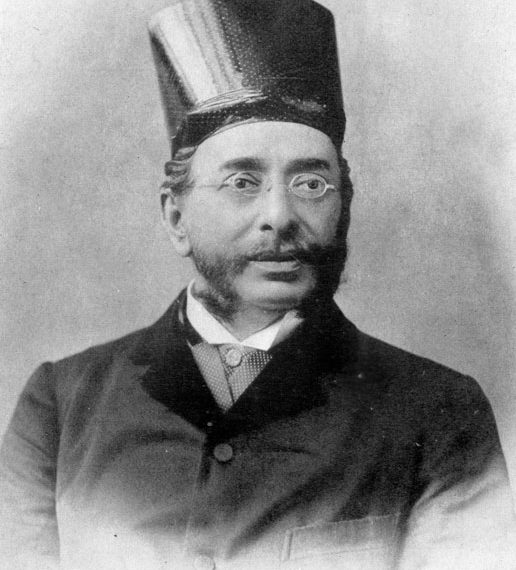
In the grand narrative of India’s struggle for independence, the early phase of constitutional agitation is often overshadowed by the later mass movements of the Gandhian era. Yet, the foundations of the modern Indian state, its parliamentary democracy, its independent judiciary, and its intricate system of local self-government were laid not on the streets, but in the legislative chambers and courtrooms of the late 19th century. At the center of this foundational period stood Sir Pherozeshah Merwanjee Mehta, a figure of such towering influence that he was simultaneously known as “The Lion of Bombay,” “Ferocious Mehta,” and the “Uncrowned King of Bombay”.
Mehta’s career represents a distinct and sophisticated mode of colonial resistance. While his mentor, Dadabhai Naoroji, formulated the economic critique of imperialism through the “Drain Theory,” and his contemporary, Bal Gangadhar Tilak, mobilized the cultural nationalism of the masses, Mehta’s contribution was structural. He was the architect of institutional resistance, a strategy that utilized the colonizer’s own legal frameworks, administrative codes, and legislative assemblies to subvert autocratic power and carve out spaces for Indian sovereignty.
The historiography of the Indian National Congress often categorizes Mehta simply as a “Moderate,” a label that implies a certain passivity or willingness to compromise. However, a forensic examination of his legal and political career reveals a radicalism disguised in the robes of a barrister. Mehta did not merely petition the British; he litigated against them. He did not just ask for rights; he demonstrated, through relentless statutory interpretation and parliamentary procedure, that the British administration was violating its own constitutional principles. His life’s work was the transformation of municipal bodies, universities, and legislative councils into arenas where the Indian intellect could challenge British administrative arrogance on equal terms.
The Crucible of Colonial Bombay
To fully grasp Mehta’s rise, one must understand the specific socio-political ecology of 19th-century Bombay. Unlike Calcutta, which was the seat of the Imperial government and dominated by the landed aristocracy and bureaucracy, Bombay was the commercial capital, built on trade, industry, and a cosmopolitan work ethic. It was a city where an indigenous bourgeoisie, comprising Parsis, Gujaratis, Bohras, and Maharashtrians, had accumulated significant wealth and social capital independent of government patronage.
Mehta emerged from the Parsi community, a Zoroastrian minority that had found refuge in India. By the mid-19th century, the Parsis had positioned themselves as intermediaries between the British and the Indian hinterland. However, Mehta, along with contemporaries like Dadabhai Naoroji and Dinshaw Wacha, led to a significant shift in the community’s trajectory. They pivoted from being purely commercial compradors to becoming the vanguard of India’s political and legal intelligentsia.
This transition was rooted in what has been identified as a distinct “Parsi legal culture,” which viewed the mastery of British law not just as a profession, but as a survival mechanism for a micro-minority. By mastering the intricate codes of the colonizer, the community could protect its interests and, by extension, the interests of the Indian nation. Mehta universalized this ethno-legal culture, applying its rigorous constitutionalism to the national cause. He operated on the belief that if the British Empire claimed to be a government of laws, then it could be held accountable by those laws.
The Triumvirate and Organized Politics
Mehta did not operate in a vacuum. Upon his return from legal studies in London in 1868, he forged a formidable political alliance with Badruddin Tyabji, a Sulaimani Bohra Muslim, and Kashinath Trimbak Telang, a Chitpavan Brahmin. Together, they were known as the “Three Bright Boys of Bombay” or the “Triumvirate”. This alliance was politically significant for its seamless inter-communal character, laying the secular foundations of Bombay’s nationalist politics long before the term “secularism” entered the Indian political lexicon.
In 1885, this trio founded the Bombay Presidency Association (BPA). The BPA was a marked departure from earlier political organizations like the Bombay Association, which had been dominated by conservative merchant-princes. The BPA represented the rising professional middle class, lawyers, journalists, and intellectuals, and became the organizational engine that powered the early Indian National Congress. Through the BPA, Mehta and his colleagues began the systematic critique of British policies, ranging from the Vernacular Press Act to the Ilbert Bill, setting the stage for the creation of a national platform.
Intellectual Foundations: The Making of a Constitutional Liberal
Pherozeshah Mehta’s political philosophy was a rigorous intellectual system forged in the classrooms of Elphinstone College and the Inns of Court in London. His brand of liberalism was a synthesis of Western constitutional theory and Indian nationalist reality.
Born on August 4, 1845, Mehta was a beneficiary of the “filtration theory” of education, but he upended its intended outcome. He graduated from Elphinstone College in 1864 and became the first Parsi to obtain a Master of Arts degree from the University of Bombay. His academic brilliance attracted the attention of Sir Alexander Grant, the Principal of the University, who nominated him as a Fellow. This early connection with the university administration would later fuel Mehta’s lifelong defense of university autonomy against state encroachment.
In 1864, Mehta traveled to London to study law at Lincoln’s Inn, being called the Bar in 1868. These four years in the metropole were transformative. He was exposed to the high noon of Victorian Liberalism, dominated by figures like Gladstone and Bright. He absorbed the British reverence for civic liberty (the inviolability of the individual against the state), the Rule of Law (the subordination of executive power to established statutes), and Local Self-Government (the conviction that political education and democracy must begin at the municipal level).
During his time in London, Mehta came under the influence of Dadabhai Naoroji, who was establishing the East India Association to lobby for Indian rights in Britain. Naoroji’s mentorship was pivotal. He instilled in Mehta the belief that the British public and parliament were ultimately rational and fair, if the case for India was presented with irrefutable logic and legal precision. This belief became the cornerstone of the “Moderate” strategy: agitation through information, petition, and constitutional pressure.
Mehta, Naoroji, and Wacha exemplified the transference of legal skill sets to national politics. This culture allowed nationalists to pivot extra-legal resistance to the business of running a state. Unlike revolutionaries who might reject the colonial court as illegitimate, Mehta viewed the court and the legislature as battlefields where the moral claims of the empire could be tested. One of his most significant intellectual achievements was the conceptual separation of the “Rule of Law” from the “Colonial Rule.” He argued that the Rule of Law was a universal value, not merely a British cultural artifact. Therefore, when he opposed British officials, he was not opposing the law; he was opposing their violation of the law. This nuance positioned the nationalist movement not as rebels against order, but as the true guardians of constitutional order against a lawless executive.
The Lawyer as Statesman: Strategic Litigation
Mehta’s legal career was inextricably linked to his politics. He viewed the law as a mechanism for exposing systemic rot, where courtroom victories often led to legislative changes.
The Arthur Crawford Case: Defending the System to Force Reform
One of the defining moments of Mehta’s early career was his defense of Arthur Crawford in the late 1880s. Crawford was the Municipal Commissioner of Bombay, a powerful British official accused of rampant corruption, bribery, and financial mismanagement. It seemed contradictory for a leading nationalist like Mehta to serve as the defense counsel for a corrupt symbol of British bureaucracy.
However, Mehta’s strategy was far more subtle. He realized that Crawford’s corruption was not just a personal failing, but the inevitable result of a flawed municipal constitution that concentrated absolute power in the hands of the Commissioner without adequate checks and balances. In defending Crawford, Mehta did not deny the chaos; rather, he argued that the chaos was systemic. He shifted the focus from the individual’s morality to the institution’s structure. By serving as Crawford’s counsel, Mehta gained intimate knowledge of the municipal machinery’s failure points. He used the scandal to argue unassailably for the necessity of a new municipal code. The Crawford affair provided the political capital required to push through the Bombay Municipal Act of 1888, which Mehta drafted. He effectively traded the defense of a British official for the structural liberty of the city.
The Caucus Case of 1907: The Triumph of Election Law
The “Caucus Case” of 1907 demonstrated Mehta’s mastery of election law and his ability to defeat a government conspiracy. By 1907, Mehta’s dominance over the Bombay Municipal Corporation was so absolute that British officials found it intolerable. A “Caucus” was formed to break his power, led by Mr. Harrison (Accountant-General), Mr. Gell (Police Commissioner), and Lovat Fraser (Editor of the Times of India). Their objective was to manipulate the municipal elections to ensure that Mehta was defeated.
The Caucus mobilized the “Justices of the Peace” (JP) constituency, organizing a strict “ticket” system that excluded Mehta. When the results were declared, Mehta stood 17th and had been unseated. Mehta did not resort to protests; he turned to the law. He challenged the election results in the Small Causes Court, represented by a brilliant young barrister named Muhammad Ali Jinnah.
The legal argument was a masterpiece of technicality:
Disqualification: They identified that the 16th-place candidate, Suleman Abdul Wahed, held a government contract with the Municipality, which disqualified him under the Municipal Act.
Precedent: Jinnah cited Queen vs. Avery, arguing that votes cast for a disqualified candidate were void.
Exhaustion of Rights: Jinnah argued that the voters who voted for Wahed had “exhausted” their right to vote; their votes could not be redistributed.
The Chief Judge accepted the argument. Wahed was disqualified, and Pherozeshah Mehta was automatically elevated to the 16th spot and declared elected. The Caucus was smashed not by political agitation, but by a writ. This victory proved that legal structures could protect Indian representatives even against a conspiracy involving the Police Commissioner. It also launched Jinnah’s political career, embedding in him a commitment to constitutional legalism.
The Father of Local Self-Government
Mehta’s true fortress was the Bombay Municipal Corporation (BMC). He treated the municipality as a “laboratory of democracy” and a “school for freedom”.
The Act of 1872: The Elective Principle
Before 1872, Bombay’s administration was vested in a Bench of Justices. Mehta agitated for reform and was instrumental in the drafting of the Bombay Municipal Act of 1872. This Act was a radical innovation, introducing the “elective principle” for the first time in India. It created a corporation of 64 members, of whom half (32) were elected by ratepayers. This gave the Indian taxpaying public a direct voice in the city’s governance.
The Act of 1888: The Magna Carta of Municipal Autonomy
The 1888 Act was a full constitution for the city. Mehta is acknowledged as the “Father of the Act of 1888,” a legislation that remains the governing charter of Mumbai to this day. His greatest innovation was the concept of “Coordinate Authorities.” He rejected the British model of a supreme executive and instead distributed power among three statutory authorities, each deriving its power directly from the Act:
The Corporation: The deliberative assembly of 72 Councilors.
The Standing Committee: A 12-member financial steering committee elected by the Corporation.
The Municipal Commissioner: The executive, usually a British ICS officer appointed by the government.
The genius of the Act lies in Section 64. While vesting “entire executive power” in the Commissioner, it subjects this power to the “approval or sanction of the Corporation or the Standing Committee” whenever the Act directs. Critically, the Commissioner cannot spend money without budget allocations approved by the Standing Committee. Mehta described this as “a strong executive responsible to the Corporation and an enlightened corporation watchful over its executive”. By controlling the purse strings through the Standing Committee, Indian representatives could effectively veto the British Commissioner’s policies.
Mehta served as the President of the Corporation four times (1884, 1885, 1905, 1911). Under his leadership, the BMC became a model of efficiency. He famously fought the imposition of “Standard Time” (linked to Railway time) and maintained “Bombay Time” for the municipality, a symbolic assertion of local autonomy against the central government. He also oversaw massive civic infrastructure projects, like the Tansa water works, proving Indians could manage complex urban systems.
The Imperial Legislative Council: The Voice of Constitutional Opposition
In 1893, Mehta was elected to the Imperial Legislative Council (ILC). He transformed the role of the Indian representative from a silent observer to a vocal Leader of the Opposition.
The Police Act of 1895: Deconstructing “Empirical Legislation”
Mehta’s first major intervention was opposing the Police Act Amendment Bill of 1895. The bill sought to give the executive power to station “punitive police” in “disturbed” areas and recover costs from inhabitants, with no judicial appeal. Mehta attacked the bill as “empirical legislation”, legislation based on the rough experience of police officers rather than the scientific principles of jurisprudence. He declared it impossible not to see it as a piece of empirical legislation “dear to the heart of executive officers” which failed to recognize that the punishment of crime must be controlled by judicial procedure. He directly challenged the impartiality of British officials, stating they were not free from the “biases, prejudices, and defects of their class”. He demanded that the executive be subject to the judiciary.
Civil Liberties and the Press Act 1910
Mehta was a champion of press freedom. When the Press Act of 1910 was introduced to curb sedition, Mehta rose in opposition. His argument centered on the removal of “Judicial Check.” The Act allowed the government to confiscate presses based on executive suspicion. Mehta argued this separated the Rule of Law from the administration, returning India to “Oriental despotism”. He asserted that if a paper was seditious, the government should prove it in a court of law. To punish without trial was to admit the government could not sustain its case in its own courts.
Defense of the Peasantry and Educational Autonomy
Though labeled an urban elitist, Mehta spoke for the peasantry, opposing the Bombay Land Revenue Bill of 1901. He argued the government’s rigidity in collecting revenue during famines caused rural indebtedness. He famously walked out of the Bombay Legislative Council in protest when the Bill passed.
Mehta also saw the defense of higher education as a political battle. Lord Curzon sought to “reform” universities to stifle political consciousness. Mehta, as a member of the Indian Universities Commission, wrote a scathing Minute of Dissent. He argued the reforms were a maneuver to destroy university independence and fill the Senate with government nominees. He asserted universities must be autonomous corporations, free from the “pedagogical handcuffs” of the bureaucracy. His dissent galvanized the academic community and delayed the implementation of repressive regulations.
To counter British control of the narrative, Mehta founded The Bombay Chronicle in 1910. He hired B.G. Horniman as editor to articulate the nationalist viewpoint. Alongside this, he helped found the Central Bank of India in 1911 to break the monopoly of British banks.
The Politics of the Congress and the Surat Split
Mehta was a founding member of the Congress (1885) but faced internal challenges from the “Extremist” faction led by Tilak. Tilak viewed constitutional agitation as futile and advocated for mass action and boycotts. Mehta feared premature mass agitation would give the British an excuse to crush the movement militarily. He wanted to preserve Congress as a legal institution at all costs.
The tension boiled over at the 1907 Surat Session. Mehta refused to allow Extremist resolutions on Boycott to pass, leading to chaos. While accused of autocracy, he ensured the Congress remained a legal entity that survived the repressive era of 1908-1914. It was a strategy for institutional preservation.
Legacy: The Constitutional State
Sir Pherozeshah Mehta died on November 5, 1915. He was the political mentor of Muhammad Ali Jinnah, whose early career was modeled on Mehta’s constitutional legalism and parliamentary brilliance. Gandhi also revered him as “The Lion of Bombay” and sought his advice.
Mehta’s most enduring legacy is the Indian Constitution itself. The values he fought for, parliamentary democracy, the separation of powers, the independence of the judiciary, and local self-government became the pillars of the 1950 Constitution. He proved an Asian nation could master modern democratic governance. Mumbai remains his monument; the BMC operates on the software he wrote in 1888.
Sir Pherozeshah Mehta demonstrated that resistance did not always require rejection of imperial institutions; it could involve their capture. By turning the law, the municipality, and the press into vehicles for Indian assertion, he hollowed out the moral legitimacy of the Raj from within. He taught a generation that the Rule of Law was a right to be wrested from the colonizer. In the courtroom and council chamber, he remains the supreme exemplar of the legal mind as a force for national liberation.
Sir Pherozeshah Mehta did not imagine freedom as an event that would arrive one day in celebration. He imagined it as something that had to be made functional long before it was declared.
For him, law was not a language of obedience but a discipline of resistance. Courts were not symbols of colonial authority alone; they were arenas where power could be questioned, delayed, constrained, and occasionally defeated. Municipal bodies were not administrative conveniences; they were training grounds where Indians learned how to govern before they were allowed to rule. Legislative councils were not decorative assemblies; they were spaces where executive power could be exposed as arbitrary when it refused to submit to legal reason.
Mehta did not dismantle the Empire by standing outside its institutions. He weakened it by forcing those institutions to behave as they claimed they did.
That method demanded patience, technical mastery, and an unshakeable belief that procedure matters even when justice seems slow. It required the courage to argue clauses instead of slogans, to fight elections in courtrooms rather than streets, and to preserve institutions even when they were unpopular.
Many who came after him chose louder paths. Some chose faster ones. But the legal architecture that allowed India to inherit courts, councils, municipalities, universities, and constitutional habits was built quietly, case by case, statute by statute, debate by debate.
Sir Pherozeshah Mehta’s resistance left no anthem behind. It left behind something harder to see and easier to forget.
A system that could be used against power because someone had once insisted that law must mean what it says.