
Emerging Legal Voices 2026
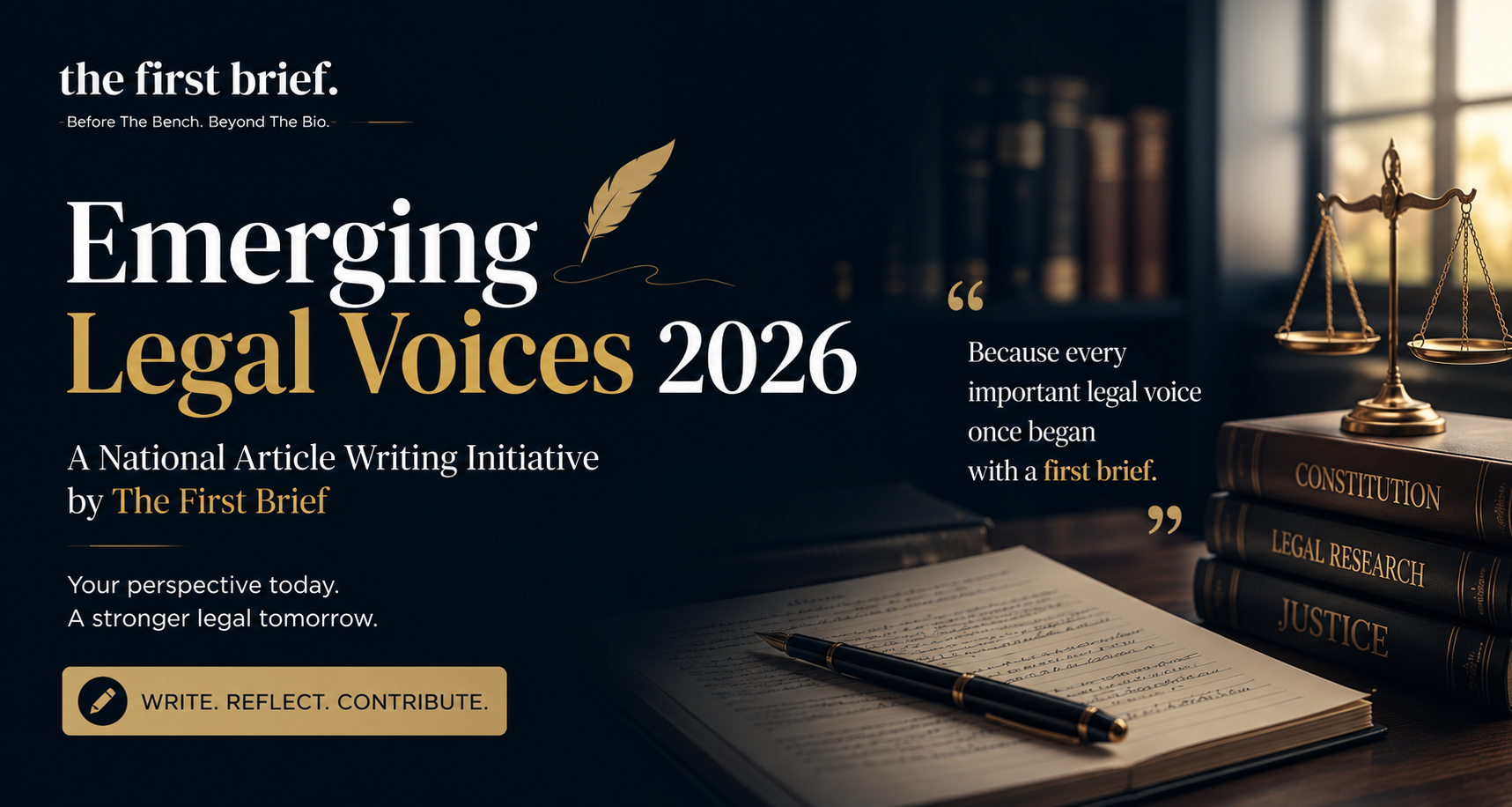
A National Article Writing Initiative by The First Brief
There comes a point in every legal journey when reading is no longer enough.
Every law student, every judicial service aspirant, every intern, and every young advocate reach a stage where they begin to look beyond textbooks, classrooms, judgments, and lectures. They begin asking questions that have no model answers. They begin forming opinions of their own. They begin to see the law not merely as a subject to study, but as a profession that demands thought, responsibility, and the courage to engage with difficult questions. It is at that moment that legal writing becomes more than an academic exercise as it becomes a way of thinking, a way of learning, a way of contributing.
At The First Brief, we believe that some of the finest legal minds are not always the ones who speak the loudest. Many are still sitting in classrooms, preparing for competitive examinations, learning during internships, or appearing before a court for the very first time. They possess curiosity, conviction, and fresh perspectives, but often lack a platform where those ideas can be heard.
Emerging Legal Voices 2026 has been created for those voices not as an article writing competition, but as an initiative that encourages thoughtful legal writing, meaningful discussion, and intellectual honesty. An opportunity to write not because you have all the answers, but because you are willing to ask the right questions.
If your words can make someone pause, think, or see an issue differently, then they deserve to be read.
Why This Initiative?
The legal profession is built upon ideas.
Every landmark judgment, every legislative reform, every constitutional debate, and every meaningful legal development began with someone who questioned existing norms and dared to think differently, and writing has always been one of the most powerful ways of participating in that conversation. Yet, many aspiring legal professionals hesitate to write. Some believe they do not possess enough experience while others assume their opinions carry little value because they are still students or early in their careers.
We disagree.
Experience undoubtedly shapes wisdom, but thoughtful writing begins much earlier. It begins with careful reading, honest research, independent thinking, and the willingness to express an idea with clarity and responsibility. That is the spirit in which this initiative has been conceived. We do not expect perfection instead we value sincerity over sophistication. We appreciate originality over ornamentation and above all, we believe that every meaningful legal career deserves an opportunity to develop its own voice.
Whether you are taking your first constitutional law class, preparing for the judicial services examination, completing your internship, or building your practice as a young advocate, your perspective matters because the future of the legal profession should not be written only by those who have already arrived.
It should also be shaped by those who are just beginning.
About Emerging Legal Voices 2026
Emerging Legal Voices 2026 is a national article writing initiative organized by The First Brief to encourage research, legal analysis, and thoughtful writing among aspiring members of the legal fraternity. The initiative seeks to provide participants with an opportunity to engage with contemporary legal issues through structured research and reasoned analysis while contributing to informed public discourse. Beyond recognizing good writing, the initiative aims to cultivate habits that remain valuable throughout a legal career like critical thinking, analytical reasoning, disciplined research, and clear communication.
The First Brief believes that legal writing should not remain confined to examinations or academic journals. It should become an integral part of how future legal professionals learn, question, and contribute to the development of law.
Theme
Should Young Advocates Become Legal Influencers?
Balancing Legal Education, Professional Ethics and Digital Presence.
The legal profession is undergoing a profound transformation. Social media platforms have created unprecedented opportunities for advocates to educate the public, simplify complex legal concepts, and make the law more accessible than ever before. At the same time, this digital shift has raised important questions about professional ethics, dignity, self promotion, client confidentiality, and the evolving responsibilities of advocates in the online space. These questions are no longer matters of casual debate. They have become the subject of serious discussion within the legal fraternity and have also found their way before the Hon’ble Supreme Court of India, reflecting the growing significance of the issue. Against this backdrop, Emerging Legal Voices 2026 invites participants to critically examine one of the most relevant questions confronting the legal profession today:
Should Young Advocates Become Legal Influencers?
Participants are encouraged to move beyond simple opinions and engage with the issue through thoughtful legal research, professional ethics, constitutional values, judicial developments, the regulatory framework governing advocates, and the realities of digital communication in the modern legal profession. The objective is not to defend a particular viewpoint, but to present a balanced, well reasoned, and legally supported analysis. Participants may argue in favor of, against, or adopt a nuanced position, provided their conclusions are supported by sound legal reasoning, credible authorities, and independent thought.
Remember, we are not looking for the “right” answer instead we are looking for thoughtful questions, careful analysis, and original legal writing that contributes meaningfully to an important conversation shaping the future of the legal profession.
Who Can Participate?
This initiative is open to:
- Law Students (Three-Year and Five-Year Programmes)
- LL.M. Students
- Judicial Service Aspirants
- Law Interns
- Young Advocates (Up to Five Years of Practice)
If you fall within any of these categories and have a legal idea worth sharing, we encourage you to participate.
Submission Guidelines
Word Limit: 1,200–1,500 words (excluding footnotes, if any).
To ensure fairness and maintain editorial standards, all participants are requested to carefully follow the Editorial Submission Guidelines before submitting their articles.
These guidelines explain:
- Eligibility requirements
- Word limits
- Formatting standards
- Citation requirements
- Use of Artificial Intelligence
- Originality and plagiarism policy
- Editorial review process
- Publication rights
- Submission procedure
Participants are strongly encouraged to read the Editorial Submission Guidelines in full before making their submission.
How Your Article Will Be Evaluated
Every submission will first undergo an editorial review to ensure compliance with the prescribed guidelines.
Eligible articles will then be evaluated on the basis of:
- Originality of thought
- Depth and accuracy of legal research
- Quality of legal analysis
- Structure and organisation
- Clarity of expression
- Practical relevance
- Overall contribution to legal discourse
Our objective is not simply to identify the “best” article, but to recognise writing that reflects intellectual curiosity, analytical discipline, and responsible engagement with the law.
Recognition
Outstanding submissions may receive one or more of the following:
- 🏆 Winner’s Award – ₹1,000
- Publication on The First Brief
- Certificate of Recognition
- Feature across The First Brief’s official platforms
- Editorial appreciation
- Opportunities for future editorial collaborations and writing initiatives
Recognition under this initiative is intended to encourage continued legal writing and meaningful participation in professional discourse.
Important Dates
Opening of Submissions: 26 July 2026
Last Date for Submission: 31 August 2026
Announcement of Winners & Selected Articles: The date will be announced after the conclusion of the submission period.
Before You Submit
Take the time to read, to think and also to question your own arguments before expecting others to question them. The strongest legal writing is rarely written in haste. It is shaped through curiosity, research, revision, and reflection.
Write with honesty. Support your ideas with authority and respect differing viewpoints.
Most importantly, write something that you would still be proud to read years from now.
A Final Word
Every experienced advocate once stood where you stand today. Every respected academic once wrote a first research paper. Every judge once struggled to understand a difficult judgment. Every legal professional began without experience. The law has always moved forward because each generation has contributed something of its own not only through advocacy inside courtrooms, but also through ideas shared beyond them.
If this initiative encourages even one participant to think more deeply, research more carefully, write more confidently, or continue contributing to legal discourse long after this edition concludes, it will have achieved something meaningful. We look forward to reading your work.
Welcome to Emerging Legal Voices 2026.
Welcome to The First Brief.
Ready to Share Your Perspective?
If you have read this far, perhaps you already have an idea waiting to be explored.
Whether your article questions an existing legal position, examines an emerging challenge, analyses a recent development, or simply offers a fresh perspective on an issue that deserves greater attention, we encourage you to write with honesty, clarity, and purpose.
At The First Brief, we do not believe that meaningful legal writing belongs only to experienced professionals. Every accomplished advocate, academician, judge, and legal scholar once began by putting their thoughts on paper for the very first time.
Perhaps this initiative is your beginning.
We invite you to become a part of Emerging Legal Voices 2026 and contribute your voice to a conversation that extends beyond classrooms and courtrooms.
We look forward to reading your work.
Frequently Asked Questions (FAQs)
1. Who can participate in Emerging Legal Voices 2026?
The initiative is open to Law Students (3-Year and 5-Year Programmes), LL.M. Students, Judicial Service Aspirants, Law Interns, and Young Advocates with up to five (5) years of practice.
2. Can I submit more than one article?
No. Each participant may submit only one original article for this edition of the initiative.
3. Can two or more authors jointly submit an article?
No. Only individual submissions are permitted.
4. What should be the word limit for the article?
Please refer to the Editorial Submission Guidelines for the prescribed word limit and formatting requirements.
5. Which citation style should I follow?
Participants must follow the citation style prescribed in the Editorial Submission Guidelines. Consistency and accuracy in citations are expected throughout the submission.
6. Is the use of Artificial Intelligence (AI) permitted?
Limited and responsible use of AI tools is permitted only in accordance with the Editorial Submission Guidelines. The article must represent your own original research, legal analysis, and intellectual contribution. Participants remain fully responsible for the accuracy, authenticity, and originality of their work.
7. Can I submit an article that has already been published elsewhere?
No. Only original and unpublished articles are eligible. Simultaneous submissions to other journals, blogs, websites, or competitions are not permitted.
8. How will my article be evaluated?
Eligible submissions will be assessed by the Editorial Board on the basis of originality, legal research, analytical reasoning, structure, clarity of expression, and overall contribution to legal discourse.
9. Will every submitted article be published?
No. Publication is subject to editorial review and selection. Submission does not guarantee publication or recognition.
10. Can I modify my submission after submitting the Google Form?
No. Once the form has been submitted, responses cannot be edited. Participants are therefore advised to review their article carefully before submission.
11. Who retains the copyright of the article?
Authors continue to own the copyright in their original work. However, by submitting an article, participants grant The First Brief a non-exclusive right to review, edit (where necessary), publish, and promote the selected submission with appropriate author attribution, in accordance with the Editorial Submission Guidelines.
12. How can I contact The First Brief regarding this initiative?
For any queries relating to eligibility, submissions, editorial guidelines, or the initiative, you may write to us at:
Email: contact@thefirstbrief.in
Terms & Conditions
Participation
Participation in Emerging Legal Voices 2026 – A National Article Writing Initiative by The First Brief constitutes acceptance of these Terms & Conditions, the Editorial Submission Guidelines, and any instructions issued by The First Brief in relation to this initiative.
Eligibility
Participation is restricted to the categories specified under the Eligibility section of this webpage. The First Brief reserves the right to seek reasonable proof of eligibility whenever required.
Originality
All submissions must be the participant’s own original and unpublished work. Plagiarism, fabricated citations, or any form of academic dishonesty may result in immediate disqualification.
Use of Artificial Intelligence
Participants must comply with the AI policy contained in the Editorial Submission Guidelines. The use of AI tools must not compromise originality, legal accuracy, or independent analysis.
Editorial Review
Every submission will undergo an editorial review before evaluation. The Editorial Board reserves the right to reject submissions that fail to comply with the prescribed guidelines or editorial standards.
Publication
Selected articles may be edited for grammar, formatting, style, or readability without altering the substance of the author’s work. Publication decisions shall remain solely at the discretion of The First Brief.
Intellectual Property
Authors retain the copyright in their original work. By participating, authors grant The First Brief a non-exclusive licence to publish, reproduce, archive, and promote selected submissions with appropriate author attribution.
Disqualification
The First Brief reserves the right to disqualify any submission that:
- violates these Terms & Conditions;
- breaches the Editorial Submission Guidelines;
- contains plagiarism or misleading information;
- is incomplete or submitted after the deadline.
Modification of the Initiative
The First Brief reserves the right to modify the schedule, theme, eligibility requirements, evaluation process, or any other aspect of the initiative whenever reasonably necessary. Any such changes will be communicated through the official website or social media platforms.
Decision of the Editorial Board
The decisions of the Editorial Board regarding eligibility, evaluation, publication, recognition, and all matters relating to the initiative shall be final.
About The First Brief
The First Brief is an independent legal platform committed to bridging the gap between legal education and professional practice. Through insightful conversations, practical resources, original publications, and community-driven initiatives, we strive to encourage informed legal thinking, meaningful dialogue, and continuous learning within the legal fraternity.
Whether you are taking your first steps in law school, preparing for the judiciary, beginning your practice, or navigating the early years of your legal career, The First Brief aims to create opportunities that support your growth before the bench and beyond the bio.

Popular Search
Copyright © 2026 The First Brief | Powered by One Devs