
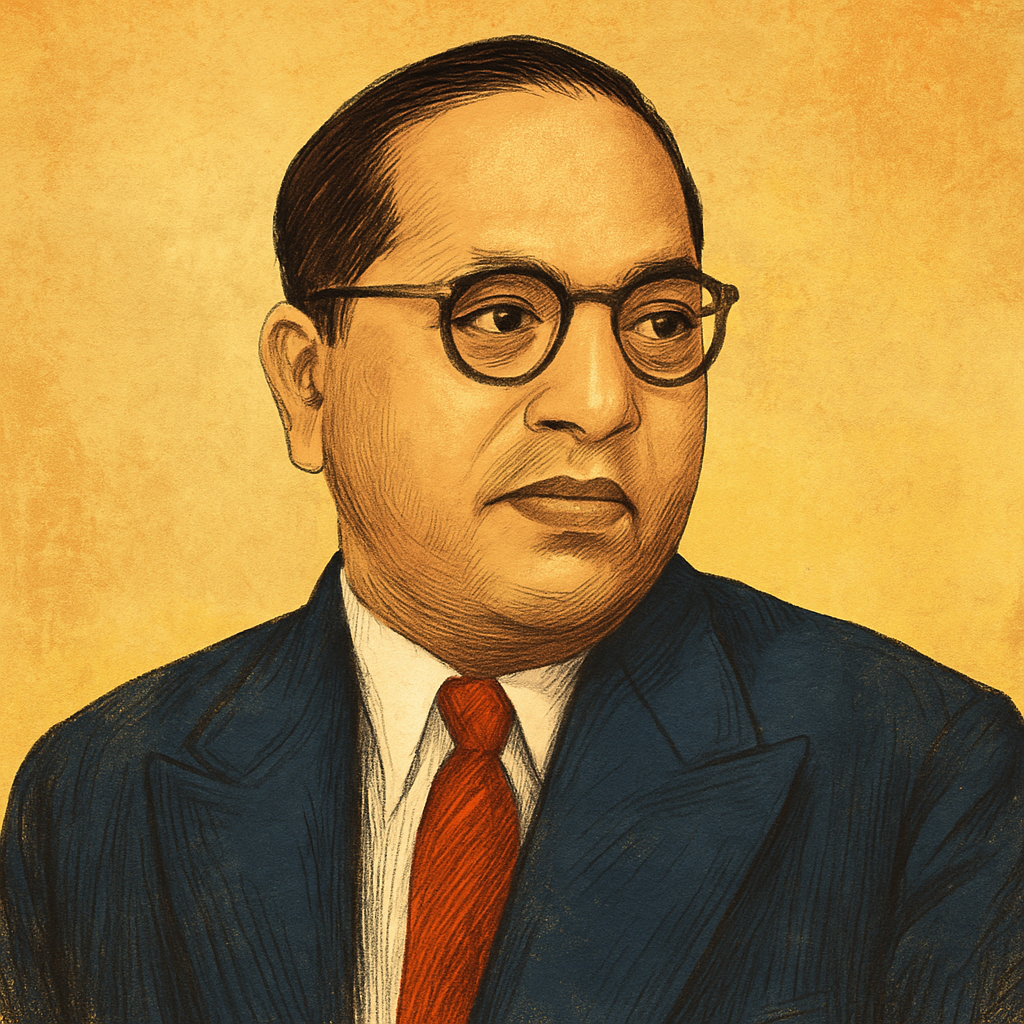
Bhimrao Ramji Ambedkar was born on April 14, 1891, in the town of Mhow (now in Madhya Pradesh, India). He was the 14th and last child of his parents, and from the very beginning he faced the sting of caste discrimination. Ambedkar belonged to the Mahar caste a community then labeled “untouchable” meaning that in the rigid social hierarchy of India, he and his people were treated as less than human. In school, young Ambedkar experienced daily humiliation as he was not allowed to sit with the other children, and he could drink water only if a school peon (attendant) poured it for him. If the peon was absent, Ambedkar and other Dalit children went thirsty, a situation he later described starkly as “no peon, no water”. Such incidents, seared in his memory, made him resolve to fight the injustice of caste.
Yet, amidst these hardships, Ambedkar’s thirst for knowledge burned bright. His father, Ramji Maloji Sakpal, had been a soldier in the British Indian Army and insisted that his children be educated. Thanks to this support, Bhimrao became the first in his community to complete high school, a monumental achievement for a Dalit boy in that era. In 1912, he graduated from Bombay University with a degree in Economics and Political Science. This was just the beginning of an extraordinary academic journey. Recognizing Ambedkar’s talent, the Maharaja of Baroda, Sayajirao Gaikwad (also known as Sayaji Rao III), gave him a scholarship in 1913 to pursue postgraduate studies abroad. He was armed with determination and with this precious opportunity, Ambedkar sailed for New York.
At Columbia University in the United States, Ambedkar gave his heart and soul. He earned a master’s degree in 1915, writing a thesis on ancient Indian commerce. He continued his research for a doctorate in economics, a rare path for any Indian at the time, let alone one from an “untouchable” background then. Columbia’s academic environment and luminary professors broadened Ambedkar’s intellectual mind. He studied under thinkers like philosopher John Dewey, who became a mentor to him. Dewey’s ideas on democracy and social justice profoundly influenced Ambedkar’s own vision of an egalitarian society. Decades later, Ambedkar fondly recalled, “The best friends I have had in my life were some of my classmates at Columbia and my great professors”, crediting the university for shaping his ideals. By 1916, Ambedkar had completed an important research paper on caste, titled Castes in India: Their Mechanism, Genesis and Development, which daringly critiqued the caste system even as he worked toward his doctorate.
Ambedkar’s academic journey next took him to London. In 1916 he enrolled in the London School of Economics (LSE) for a D.Sc. (Doctor of Science) in Economics and joined Gray’s Inn to train as a barrister in law. However, midway through these studies, his Baroda scholarship funds ran out. Ambedkar was forced to return to India in 1917 without completing the London degrees. Back home, he briefly worked as a professor of Political Economy at Sydenham College in Bombay. Even as a teacher, his reputation as a brilliant mind grew, but he never gave up the dream of finishing his education. With the financial help of another monarch, the Maharaja of Kolhapur, and his own savings, Ambedkar returned to London in 1920 to resume his studies and the results were remarkable. He completed a master’s degree in 1921 and went on to earn his D.Sc. in Economics from LSE by 1923. Simultaneously, Ambedkar finished his law studies and was called to the Bar in 1922, becoming qualified as a barrister in England. In these few intense years, he collected an array of prestigious credentials, he now held multiple doctorates and law degree, an achievement unheard for an Indian of his time. His London doctoral thesis, a deep analysis of India’s currency problems, was published as The Problem of the Rupee: Its Origin and Its Solution in 1923. (This work would later play a role in shaping India’s central banking policy, showing how Ambedkar’s scholarship was not just ivory tower research but had direct practical impact.) Dr. Ambedkar had become one of the most educated individuals in colonial India, using education as the tool to break barriers that society had imposed on him.
A Voice for the Voiceless: Social Reformer in the 1920s
Armed with his degrees and determination, Ambedkar returned to India in 1924. He immediately turned himself into efforts to uplift the community he came from, the millions of people considered “untouchables” or Dalits who had endured oppression for centuries. In July 1924, he founded the Bahishkrit Hitakarini Sabha (literally, “Association for the Welfare of the Excluded”). The mission of this organization was clear from its name; it sought to spread education and improve the socio-economic status of the ostracized classes, and to make their voices heard. Ambedkar understood that social ostracism was sustained not only by outdated laws but also by a lack of access to resources like education, water, and land. So, he began organizing and agitating to secure basic civil rights for Dalits. He started Marathi-language journals like Mooknayak (Leader of the Dumb) and later Bahishkrit Bharat, through which he exposed caste injustices and mobilized public support for reform. His words gave hope to those who had been told for generations that they had no place in society’s mainstream.
One of Ambedkar’s early and most famous campaigns was the Mahad Satyagraha of 1927. In the town of Mahad in Maharashtra, a public tank (water reservoir) was traditionally forbidden to Dalits. Ambedkar led a large gathering of men and women from the “untouchable” communities to assert their right to drink the water from this tank, openly defying caste Hindus who insisted the water would be “polluted” by their touch. He encouraged Dalits to come forward, and in a historic act of civil disobedience, they sipped water from the tank. This dramatic protest was not just about water; it was about dignity and equal access to public resources. Caste bigots reacted by attacking the participants and even legally challenging their action, leading to what became known as the Chavadar Tank case. Ambedkar, as a lawyer, helped defend the right of the Dalits to use the tank, arguing successfully in court that the water body was public property and open to all. The court agreed that long-standing exclusion could not turn a public tank into private Brahmin property. This victory was a significant milestone it was a legal affirmation that untouchability had no place in law when it came to public utilities. It also showed Ambedkar’s dual approach: using activism on the streets combined with arguments in the courtroom to fight social injustices.
Around the same time, Ambedkar launched movements for temple entry rights. In many Hindu temples, Dalits were not allowed to enter or worship. Ambedkar argued that banning a person from a temple on account of birth was a grotesque denial of basic human equality. In 1930, he led a temple entry Satyagraha at the Kalaram Temple in Nasik, where thousands of Dalits marched to assert their right to pray in a public temple. Although orthodox opposition prevented them from entering that day, the protest sent shockwaves through Indian society. It announced that the “untouchables” would no longer passively accept their lot they were organizing under a bold leader to claim their rights. As one account from that period summed up, Ambedkar was initiating protests caste discrimination in both water and worship, attacking the very core of untouchability. These acts of resistance galvanized Dalits across India and put social reform on the agenda of national politics.
Ambedkar’s prominence as a leader of the oppressed classes grew through the 1920s. The British colonial government took note of this articulate, English educated barrister who was campaigning for the rights of those at the bottom of the social ladder. In 1927, recognizing his stature, the Governor of Bombay nominated Dr. Ambedkar to the Bombay Presidency Legislative Council. Now Ambedkar had a new platform within the council; he could argue about laws and policies to abolish social disabilities. He used his position to advocate for the labor rights of workers and for affirmative action to uplift depressed classes. Dr. Ambedkar’s incisive arguments and the moral force of his cause made fellow legislators pay attention, even if they did not always agree.
By the late 1920s, the question of India’s future and how all communities would find their place in an independent India had become pressing. The British set up the Simon Commission in 1928 to propose constitutional reforms. Ambedkar prepared a detailed submission for the Commission, demanding universal adult franchise (voting rights for all adults, including the lowest castes) and stressing that any new constitution must consider the needs of the marginalized. He did not want political freedom from the British without social freedom for Dalits. When the Commission’s work led to a series of high profile negotiations called the Round Table Conferences in London (1930–1932), Dr. B.R. Ambedkar was chosen as a delegate to represent the “Depressed Classes” of India. In these conferences, Ambedkar sat at the table with British officials and Indian leaders of the stature of Mahatma Gandhi, discussing how to shape India’s future governance. He argued forcefully that without specific safeguards, Dalits would remain politically voiceless under majority rule. One of his key demands was for separate electorates, a system where Dalits would vote for their own representatives from reserved constituencies so that their political representation could be guaranteed, free from domination by the upper castes. The British government agreed to this in the “Communal Award” of August 1932, which granted separate electorates for several minorities including Dalits. However, this led to a profound confrontation with Mahatma Gandhi, who opposed dividing voters by caste or religion. Gandhi went on a fast-unto-death in jail to protest the Dalit separate electorate, believing it would fragment Hindu society. The crisis pushed Ambedkar into a painful corner as he faced the moral dilemma of Gandhi’s life versus the political rights of his people. Ultimately, Ambedkar decided to compromise to save Gandhi’s life and avoid civil unrest. He signed the Poona Pact in September 1932, reluctantly giving up the demand for separate electorates. In return, the Pact provided for a higher number of reserved seats for Dalits in the provincial legislatures, though these Dalit candidates would now be elected by the general joint electorate. Ambedkar was not happy with this outcome; he famously stated that Gandhi’s fast had been a form of “blackmail,” forcing him to sacrifice a principled demand. Nevertheless, the Poona Pact was watershed. It brought the issue of untouchability into the forefront of India’s freedom movement, and it paved the way for the principle of reserved seats that would later be enshrined in the Indian Constitution. Ambedkar had ensured that the cause of his people would not be ignored in the march toward independence.
Legal Career: Fighting from the Courtroom
While Ambedkar’s social activism was making waves, he was also building a distinguished legal career in the 1920s and 1930s. After qualifying as a barrister in London, he had the credentials to practice law at the highest levels. In 1923, Dr. Ambedkar was formally admitted to the Bombay High Court as an advocate. He started his legal practice with very humble beginnings – unlike many established lawyers of the time, Ambedkar came from a community with no big connections or moneyed clients. He set up a practice at a small office in Bombay and often took up cases for poor clients or for the causes he believed in. Yet his sharp legal mind and eloquence soon earned him a reputation. Through the 1920s, he argued several influential cases. Many of these cases had a social dimension, reflecting Ambedkar’s tendency to use law as an instrument of social justice.
For instance, in 1927 Ambedkar served as a legal defense counsel in the case of Philip Spratt, a young Englishman and founding member of the Communist Party of India who had been arrested for sedition. Spratt had published a pamphlet called India and China that criticized imperialism. Ambedkar, as part of the defense team, contended that voicing general anti-imperialist ideas was not the same as inciting rebellion against the government. The court was persuaded by this argument, the pamphlet was deemed a general commentary rather than a direct attack on the state, so the charge of sedition did not hold. This case not only showed Ambedkar’s legal acumen, but also his principled stand on free expression; he was willing to defend even a communist’s right to criticize colonial policies, despite not being a communist himself.
In the famous Chavadar Tank case which followed the Mahad Satyagraha, Ambedkar again played a key role behind the scenes in crafting the legal strategy. The orthodox opponents had sued to prevent Dalits from using the water tank, claiming it was private property. Ambedkar argued the opposite that the tank was managed by the municipality (the government) and was hence a public resource. The court’s decision vindicated Ambedkar’s stance: it ruled that the tank was indeed public and open to all, and that no group could claim exclusive ownership simply because they had traditionally prevented others from access. This outcome gave a legal stamp of approval to the equality movement.
Ambedkar also took on cases related to labor rights and social freedoms. In 1934, he defended the All India Textile Workers’ strike by highlighting flaws in the colonial labor laws, particularly the Trade Disputes Act of 1929. He exposed how the law was skewed against workers, and his arguments helped the workers’ cause, forcing some pro-labor amendments. In another case, he came to the defense of Professor R.D. Karve, who ran a progressive magazine on sexual health and birth control (called Samaj Swastya). Prof. Karve was prosecuted under obscenity charges. Ambedkar championed Karve’s freedom of expression, and the case was eventually dropped, marking an early victory for sexual education and freedom of the press in India.
Through such high-profile trials and numerous smaller cases (including disputes over worker compensation, tenant rights, and caste discrimination), Dr. Ambedkar rose to be one of the leading lawyers of his time. The British even offered him a judgeship: at one point he was invited to serve as a district judge, and the Nizam (ruler) of Hyderabad sought to appoint him as Chief Justice of that princely state. Remarkably, Ambedkar turned down these honors. He felt that becoming a judge, tied to the establishment, might restrain his ability to fight for social and political change. In a 1951 speech, he reflected on this decision, saying: “I declined the offer… I feared that after getting into government service I would not be able to serve my people”. This choice exemplified Ambedkar’s character personal career advancement took a backseat to his mission of uplifting the marginalized. He wore the black coat of a barrister, but in his heart, he was always an advocate for the oppressed.
Political Leadership and the Making of the Constitution
By the mid-1930s, Dr. Ambedkar had established himself not only as a scholar and lawyer, but also as a national leader championing the rights of the downtrodden. In 1936, he formed his own political party called the Independent Labour Party (ILP). This party was unusual for its time: it aimed to represent the interests of both the “Depressed Classes” (Dalits) and the working-class poor of all communities. Ambedkar realized that caste oppression related to economic exploitation, so the ILP’s platform was built on social justice as well as labor rights. The ILP contested the provincial elections in 1937 and achieved a remarkable result in Bombay province winning 15 of 17 seats it contested, including most of the reserved seats for untouchables. This electoral success proved that Ambedkar was not just a leader in theory but had mass support on the ground. Over the next years, the ILP and Ambedkar organized rallies of tens of thousands of peasants and industrial workers, demanding fair laws for tenants, minimum wages, and the right to organize. One such memorable protest in 1938 saw Ambedkar leading a march of 20,000 farmers to protest exploitative landlord practices the largest peasant demonstration in pre-independence India. Though Ambedkar and the Congress Party (led by figures like Gandhi and Nehru) differed in many ways, by the 1940s there was no denying his influence and importance as the voice of millions who had been voiceless.
When World War II was raging and the question of India’s independence could no longer be postponed, the British administration included Dr. Ambedkar in the Viceroy’s Executive Council (the cabinet of pre-independence India) as Labour Member in 1942. In this ministerial role during 1942–1946, Ambedkar tirelessly worked to enact pro-worker policies. He wrote a comprehensive “Labour Charter” in 1945, advocating for things like fair wages, decent working conditions, and social security for workers. Many of these ideas later informed independent India’s labor laws. In fact, Ambedkar is credited with introducing what became the tripartite framework for labor relations in India (involving negotiations between employers, employees, and the government). This was a precursor to modern labor dispute resolution in India, again highlighting how Ambedkar was ahead of his time in policy thinking.
As the British prepared to quit India, fresh elections were held and a Constituent Assembly was convened in 1946 to draft the Constitution for free India. Initially, Ambedkar faced political setbacks he lost an election in Bombay, and it seemed he might not have a seat in the Constituent Assembly. But the Assembly had reserved seats for minorities, and Ambedkar was eventually elected from Bengal (with help from fellow legislators who admired his capabilities). It was a stroke of fortune for the nation. When India achieved independence on August 15, 1947, Prime Minister Jawaharlal Nehru reached across political differences to invite Dr. B.R. Ambedkar to join the new government as the first Minister of Law and Justice of independent India. Nehru and other top leaders knew that Ambedkar’s legal expertise and deep intellect were invaluable for the monumental task ahead which is framing the Constitution of India.
Sure enough, Ambedkar was soon after appointed Chairman of the Drafting Committee of the Constituent Assembly, effectively the chief architect of the Indian Constitution. Over the next three years (1947–1949), he worked nearly around the clock with the committee and the Assembly, guiding the process of drafting, debating, and refining the Constitution’s text. Despite frail health and bouts of illness, Ambedkar demonstrated unwavering dedication. One colleague in the Assembly, Mahavir Tyagi, described him as “the main artist” who carefully crafted the Constitution, as if painting a masterpiece for all to admire. Dr. Rajendra Prasad, President of the Constituent Assembly (and later India’s first President), paid Ambedkar perhaps the highest tribute by saying: “We could never make a decision… so right as when we put him on the Drafting Committee and made him its Chairman… He has not only justified his selection but has added lustre to the work…”. Under Ambedkar’s leadership, the Drafting Committee sifted through hundreds of suggestions, petitions, and provisions, producing a coherent document that would serve a nation of 350 million people with immense diversity.
Ambedkar’s imprint on the Indian Constitution of 1950 is deep and indelible. He ensured that the Constitution would guarantee fundamental rights to all citizens, rights to equality, freedom of religion, and legal due process, among others. He was adamant that untouchability be abolished; thanks to him, Article 17 of the Constitution explicitly outlaw’s untouchability in any form. He advocated for a federation with a strong center but also strong states, which is reflected in India’s federal structure. Ambedkar also took care to include provisions for affirmative action (known in India as “reservations”) in education, employment and legislatures for the Scheduled Castes and Scheduled Tribes – mechanisms to help remedy historical injustices. “Political democracy,” he argued, would not last if it was not accompanied by social democracy. Hence, the Constitution embodies the ideals of liberty, equality, and fraternity in its Preamble, ideals Ambedkar held as the trinity of a just society. Moreover, as Law Minister, he introduced the landmark Hindu Code Bill, a set of laws to reform Hindu personal law by giving women equal rights in marriage and inheritance. This was revolutionary in a society steeped in patriarchal traditions. Ambedkar passionately championed women’s rights through this legislation, declaring that he would rather resign than compromise on equality for women. Unfortunately, due to political opposition, the Hindu Code Bill stalled in late 1951, causing Ambedkar to resign from the Cabinet in October 1951. He felt that the government was not doing enough to combat casteism and gender inequality, and he chose principle over his ministerial seat.
On January 26, 1950, the day the Constitution came into force, India’s people owed a great debt to Dr. Ambedkar’s vision and hard work. He famously cautioned independent India not to be content with mere political freedom. In his final speech to the Constituent Assembly, he warned of the dangers of inequality and hero-worship in politics, urging Indians to “educate, agitate, and organize” to preserve their hard-won freedoms, echoing the motto he had lived by. After the Constitution was adopted, Ambedkar served as a member of the Rajya Sabha (Upper House of Parliament) from 1952 until the end of his life, continuing to speak out for social justice from the legislative floor. In 1952, in a fitting recognition of his scholarship and contributions, Columbia University (his alma mater) bestowed on him an honorary Doctor of Laws (LL.D.) degree. The same year, Osmania University in India also awarded him an honorary doctorate. The world was acknowledging what millions of Indians already knew that Babasaheb Ambedkar (as he was affectionately called) was a nation-builder of the highest order.
Beacon of Change: Writings and Ideas
Apart from being a lawmaker and leader, Dr. Ambedkar was a prolific writer and an intellectual rebel. Throughout his life, through books, essays, and speeches, he challenged orthodox ideas and proposed bold reforms. Many of his writings became manifestos for social and economic change in India. Here are a few of his most influential works that showcase his legal, political, and social thought:
- Annihilation of Caste (1936): Originally written as a speech for a conference of progressive Hindu scholars, this essay became Ambedkar’s most famous critique of the caste system. In it, he argued that caste was a vicious system of graded inequality and that Hindu society needed a complete moral revolution to annihilate caste. The organizers of the event were so startled by Ambedkar’s frank denunciation of orthodox religion upholding caste that they cancelled his speech. Undeterred, Ambedkar published it as a booklet himself. Annihilation of Caste boldly called for the excommunication of the caste doctrine, even suggesting that Dalits might have to leave Hinduism to achieve true social equality. This work inspired generations of activists and remains a seminal text for those fighting caste-based discrimination.
- The Problem of the Rupee: Its Origin and Its Solution (1923): This was Ambedkar’s doctoral thesis at the London School of Economics, later published as a book. In this rigorous economic study, Ambedkar traced the history of India’s currency and argued for a stable monetary policy. He analyzed how colonial monetary policies (like the silver standard) had caused instability. Ambedkar proposed the establishment of a central bank to manage currency and credit – ideas that directly influenced the creation of the Reserve Bank of India (RBI) in 1935. The Hilton Young Commission, which recommended the RBI’s formation, drew on Ambedkar’s suggestions for stabilizing the rupee. Thus, Ambedkar’s economic thinking left a lasting institutional legacy in India’s financial system.
- States and Minorities (1947): As India was on the verge of independence, Ambedkar prepared this lengthy memorandum for the Constituent Assembly’s Sub-Committee on Fundamental Rights. States and Minorities is essentially Ambedkar’s draft for a just Constitution. It not only urged safeguards for the Scheduled Castes (Dalits) but also laid out a comprehensive vision for socio-economic democracy. It included a proposed preamble and articles guaranteeing citizens extensive social and economic rights – far beyond what the eventual Constitution included. Notably, Ambedkar advocated for “state socialism”, suggesting that key industries and agriculture should be collectively owned or state-controlled to ensure redistribution of wealth. He wanted constitutional protection against economic exploitation, in addition to political rights. While the final Constitution did not adopt Ambedkar’s socialist clauses (a compromise he accepted in the Assembly), States and Minorities stand as evidence of his far-reaching foresight on issues of minority rights and equitable economic development. Scholars have called it the strongest articulation of social and economic rights of its time.
Ambedkar’s other writings also left deep imprints. In Who Were the Shudras? (1946), he delved into ancient history to examine the origins of the Shudra (low caste) class, debunking myths that justified caste hierarchy. In The Buddha and His Dhamma (published posthumously in 1957), Ambedkar presented an insightful interpretation of Buddhism, the religion he adopted, as a creed of social equality and rationalism. Through all his works, a common thread runs: a relentless pursuit of justice social, economic, and political. He combined scholarly evidence, sharp analysis, and moral passion to make the case that a just society is not only desirable but achievable, if we are willing to embrace radical change in our attitudes and structures.
Final Years and Legacy
By the mid-1950s, Dr. Ambedkar had accomplished more than most could in multiple lifetimes, but the rigors of his struggles took a toll on his health. He was diabetic and suffered from weak eyesight and other ailments. Despite this, he kept working, writing, and campaigning. One unfinished mission of his life was spiritual liberation for his people. Ambedkar had long concluded that the caste system was so deeply embedded in Hindu religion that for Dalits to be truly free, they might have to change their faith. As early as 1935, he declared in a public conference, “I was born a Hindu, but I will not die a Hindu”, sending shockwaves through orthodox India. True to his word, in October 1956, just weeks before his passing, Ambedkar led one of the greatest mass religious conversions in history. On October 14, 1956, in Nagpur, he embraced Buddhism in a formal ceremony, along with roughly half a million of his followers. Buddhism, with its core values of equality and compassion and its rejection of caste, appealed to Ambedkar as the religion of social emancipation. In that ceremony, he recited the Three Jewels and Five Precepts of Buddhism and vowed to live by its teachings. This peaceful revolution in religion was the capstone of his life’s work: it symbolized breaking free from the shackles of caste-based Hindu orthodoxy and choosing a path of liberty, equality, and fraternity, the same principles he had enshrined in the Constitution.
Less than two months later, on December 6, 1956, Dr. B.R. Ambedkar passed away in his sleep at his home in Delhi. He was 65 years old. News of his death plunged the nation into shock and grief. Millions of Dalits felt orphaned, as if a protective father figure had left them. Leaders across the spectrum paid homage to this indomitable fighter for justice. In accordance with Buddhist tradition, Ambedkar was given a cremation befitting a great leader, at Dadar Chowpatty in Bombay, where large throngs gathered to bid farewell. That day, many more of his followers embraced Buddhism, underscoring how deeply he had inspired them to seek change in every dimension of life.
Dr. Ambedkar’s legacy only grew after his death. In 1990, the Government of India posthumously honored him with the Bharat Ratna, the country’s highest civilian award, recognizing his role as “the architect of the Indian Constitution” and as a lifelong crusader against social injustice. His birthday, April 14, is observed as Ambedkar Jayanti and is a public holiday in India, celebrated with reverence by millions. Statues and portraits of Ambedkar often showing him holding the Constitution are found in almost every town and village across India, a testament to the hope he continues to represent for the marginalized. He is affectionately called “Babasaheb,” meaning respected father, by people whose lives he touched. Ambedkar’s writings and speeches are studied widely; they continue to challenge and inspire new generations to fight prejudice in all forms. The social movements for Dalit rights, affirmative action policies, and legal safeguards in modern India all draw upon his ideas. He laid the foundation for India’s affirmative action (reservation) system that has helped uplift historically oppressed communities in education and jobs. His advocacy for women’s rights has borne fruit in progressive laws that came after him. And his warnings about the dangers of caste and communalism are cited by those working to preserve India’s secular and democratic fabric.
Around the world too, Ambedkar’s impact has been recognized. The United Nations celebrated his 125th birthday in 2016, acknowledging his contributions to social justice. Perhaps one of the most powerful tributes came from the U.S. President Barack Obama, who, while addressing the Indian Parliament in 2010, invoked Ambedkar’s story as an inspiration. Speaking of the shared values of the United States and India, Obama said: “Just as a Dalit like Dr. Ambedkar could lift himself up and pen the words of the Constitution that protects the rights of all Indians, we believe that no matter who you are or where you come from, every person deserves the same chance to live in security and dignity”. It was a profound acknowledgment that a man born into oppression rose to frame the laws of a free nation, a journey that epitomizes the progress that democracy makes possible.
Dr. Bhimrao Ramji Ambedkar’s life is a tale of resilience, intellect, and unwavering commitment to equality. He transformed the pain of his early experiences into a profound determination to remake society based on justice. In the courtroom, in the legislature, and in the streets, he fought for the idea that all human beings are equal and that the law must protect the poorest and weakest. He was a lawmaker who never lost sight of the law’s highest purpose: to uplift humanity. From abolishing untouchability to securing fundamental rights, from advocating labor welfare to ensuring religious freedom, Ambedkar’s contributions shaped modern India’s identity as a democratic, inclusive nation. His story, told in simple words, is not just history it is a beacon for anyone who believes in the power of ideas to overcome injustice. Ambedkar showed that knowledge is liberating, that the tools of democracy and law can be wielded to break ancient shackles. Above all, he taught India to embrace the value of “Bahujan Hitaya, Bahujan Sukhaya” the welfare and happiness of all. In remembering Dr. B.R. Ambedkar, we remember the promise of an India (and a world) where social liberty, political equality, and human dignity triumph against all odds. His life remains an inspiring guide for the journey towards a more just and compassionate society.
As we close this week’s Briefs of Freedom, we remember Dr. B.R. Ambedkar not merely as the framer of a constitution, but as the conscience of a country. His words gave law its purpose, his vision gave freedom its depth, and his life gave voice to millions long kept silent. In the courtroom, in the legislature, and in the pages of India’s destiny, Ambedkar didn’t just argue for justice, he built it, brick by brick.