
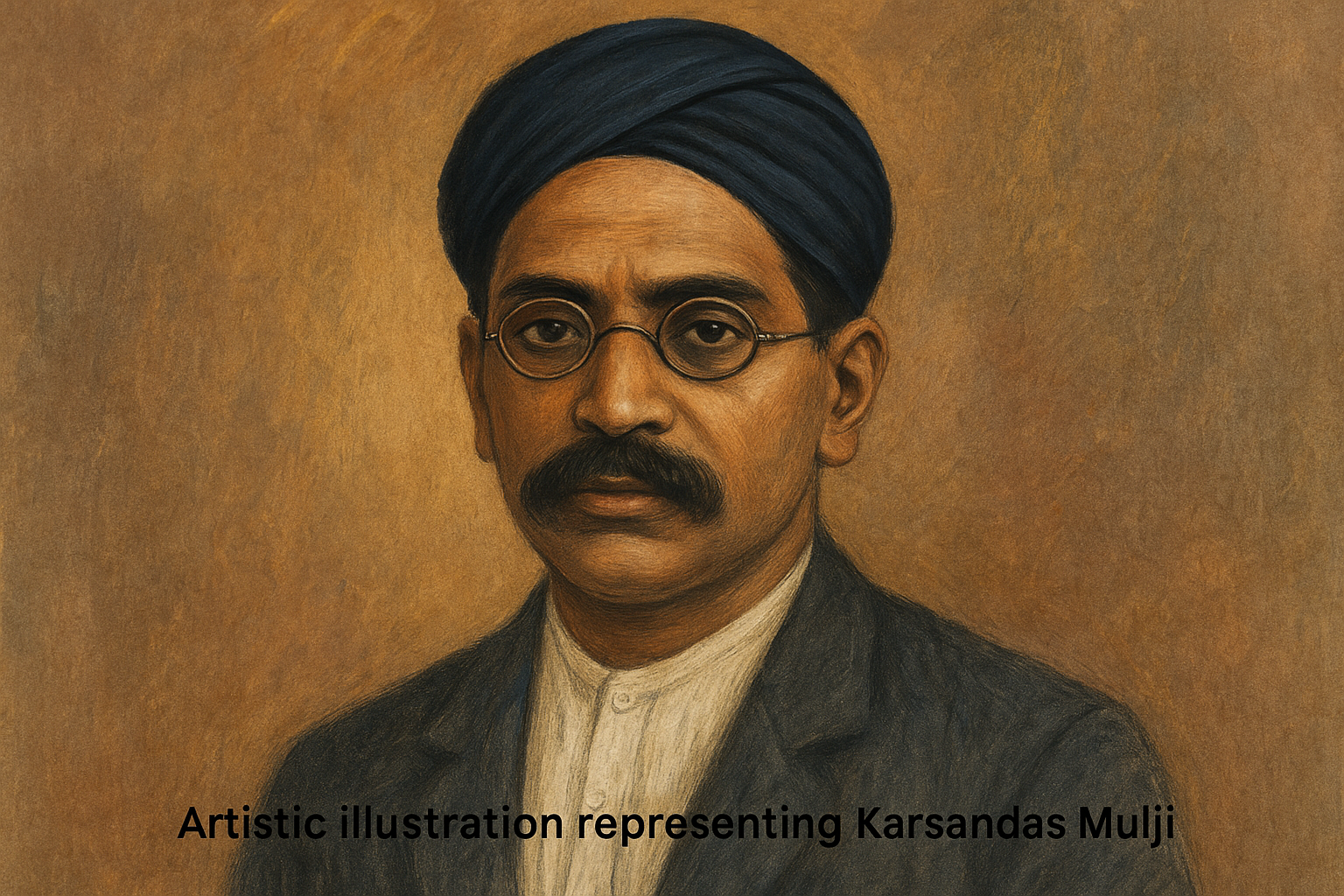
In 1862, a packed courtroom in Bombay witnessed an extraordinary trial. A young Gujarati journalist, Karsandas Mulji, stood accused of libel by a powerful Hindu religious leader the Maharaj of a popular Vaishnav sect. The charges stemmed from Mulji’s daring exposé of alleged misconduct by the guru. As British judges presided, scandalous details of secret rites spilled into the open. The trial electrified colonial India, pitting freedom of the press and social reform against orthodox authority in an arena where tradition and modern law collided.
Karsandas Mulji (1832–1871) was a pioneering journalist and social reformer who used his pen and the courts to challenge religious orthodoxy in 19th-century India.
Early Life and Reformist Beginnings
Karsandas Mulji was born in 1832 into a Gujarati Hindu business (Bania) family and raised in the Vaishnavite Pushtimarg sect. He received both traditional schooling and an English education, which exposed him to new liberal and rational ideas taking root in Bombay. Under the mentorship of thinkers like Dadabhai Naoroji, the eminent scholar and early nationalist young Mulji developed a critical eye toward the injustices around him. By his early twenties, he was writing for Naoroji’s Anglo-Gujarati paper Rast Goftar, honing a voice that would soon challenge India’s social norms.
At age 23, Mulji launched his own weekly journal in Gujarati, Satyaprakash (meaning “Light of Truth”), in 1855. This paper became his platform to shine a light on entrenched orthodox practices. In its pages, Mulji boldly questioned what many hesitated to even discuss openly. He and a circle of like-minded reformers used Satyaprakash to confront a wide range of social ills and superstitions among their communities:
- Oppression of women: Mulji decried child marriage, the forced seclusion of women, and the cruel treatment of widows, advocating for women’s education and the right of widows to remarry.
- Caste and social customs: He joined reformist “discussion mandalis” that secretly broke caste taboos (even sharing meals across caste lines) to push back against rigid hierarchies. Mulji believed society must value reason over ritual and morality over caste status.
- Religious hypocrisy: Perhaps most controversially, he took aim at corruption among Hindu religious leaders. In one early article titled “Hinduo No Asli Dharam Ane Atyarna Pakhandi Mato” (“The True Religion of Hindus and the Hypocrisy of the Present Leaders”), Mulji accused certain sect gurus the Maharajs of the Pushtimarg of straying from genuine Hinduism and indulging in immoral behavior.
Mulji’s fearless writings earned him admiration from progressive Indians, who saw him as a moral visionary, but also fierce hostility from orthodox circles. Conservative religious and caste leaders viewed the young editor as a heretic violating sacred boundaries. By the late 1850s, pamphlets, debates, and newspaper wars were raging in Bombay’s Gujarati society, with Mulji at the center. Unbeknownst to him, these battles of ideas were about to spill into the courts with consequences that would make history.
The Maharaj Libel Case of 1862: Reform on Trial
The flashpoint came with Mulji’s investigative piece in Satyaprakash in 1860. In this article, he directly exposed Jadunathji Brijratanji Maharaj, a revered guru of the Vallabhacharya Pushtimarg sect, accusing him of exploiting female devotees under the guise of religious ritual. Mulji even cited an obscure book by a descendant of Vallabhacharya that seemed to endorse such immoral practices, using the sect’s own theology to indict its leader. The allegations were explosive: that a Maharaj, regarded by followers as a divine guide, was seducing or coercing women devotees.
The Maharaj and his followers reacted with outrage. Leaders of the sect launched a campaign to discredit Mulji and silence his paper. According to reports, the Maharaj’s devotees in Bombay organized a signature petition (which Mulji mockingly labeled a “gulami khat” or bond of slavery) pledging loyalty to the guru. The Maharaj convened mass meetings, even warning that any member of the community who dared testify in Mulji’s favor would be excommunicated. The pressure on Mulji was immense at one point temple doors were shut and women devotees wailed in the streets calling for the reformer’s death yet he refused to back down.
In 1861 Jadunathji Maharaj filed a defamation lawsuit against Karsandas Mulji and his publisher, Nanabhai Rustomji Ranina. He demanded an unprecedented ₹50,000 in damages (an astronomical sum at the time) for the alleged libel. Mulji welcomed the legal battle, asserting that everything he published was true and in the public’s interest to know. Thus began the famous Maharaj Libel Case, heard in early 1862 before the Supreme Court of Bombay (the highest colonial court in the region).
For over three months, the courtroom became a battleground between orthodoxy and reform. The trial opened on January 25, 1862, and each day’s testimony was avidly reported in the press, with crowds thronging outside to get news. The Maharaj’s legal team produced 31 witnesses, attempting to prove Mulji’s claims were baseless and defamatory. These included sect followers who insisted the guru’s conduct was misrepresented. Mulji’s side, however, brought forward 33 witnesses, among them disinterested professionals, missionaries, doctors, even former insiders who corroborated accounts of the Maharaj’s alleged “spiritual” debauchery.
The proceedings often took on the air of a theological inquiry. British judges and lawyers, largely ignorant of Hindu sectarian nuances, struggled to grasp concepts of guru worship and Hindu scripture. At one point an expert witness, the noted Orientalist Dr. John Wilson, was called to explain Hindu texts a Presbyterian missionary dissecting Krishna lore and Puranic verses before a secular court. The Maharaj’s followers declared their guru to be a divine incarnation, beyond ordinary morality, while Mulji’s side read aloud verses and songs used in the sect that enjoined female devotees to surrender themselves to the Maharaj. This clash of worldviews was stark: the colonial court demanded rational evidence and moral standards, whereas devotees spoke of mystical devotion. As one observer noted, there was a complete “mismatch of the court’s paradigm and the devotees’ understanding of bhakti”.
Revelation after revelation kept Bombay society scandalized. Witnesses described young women singing lewd songs to the Maharaj, invoking him as Krishna and themselves as the Gopis in divine love-play. A civil surgeon testified that Jadunathji Maharaj was being treated for syphilis, a medical confirmation of his sexual affairs. Mulji himself took the stand, unflinchingly detailing what he saw as a “horrid and revolting superstition” that enabled the guru’s carnal exploitation. He painted the Maharaj as a fraud who taught that sleeping with the guru was the path to salvation, a revelation that sent gasps through the courtroom and made headlines in English and newspapers alike.
Finally, on April 22, 1862, the judges delivered a nuanced but ultimately historic verdict. By all accounts, it was a resounding vindication for Karsandas Mulji despite a technical finding against him. Chief Justice Sir Matthew Sausse held that Mulji’s writings, though true, had technically defamed the Maharaj by exposing private “spiritual” matters to public scrutiny, in Sausse’s view, such intra-community issues ought not to have been published. On that narrow point, the court ruled Mulji guilty of libel, but only in the most nominal sense. The Maharaj was awarded a mere ₹5 in damages, a token sum that underscored how trivial his claim was. In contrast, Justice Joseph Arnould issued a powerful concurring opinion defending Mulji: he declared that a journalist performing a public duty to “correct misconduct” had committed no offense at all. Arnould praised Mulji’s courage in exposing wrongdoing, likening him to a social Martin Luther who had sparked a revolution in public morality.
Importantly, both judges agreed on the essential facts that Mulji had published the truth and that the Maharaj’s practices were indeed “corrupting and licentious.” They stated unequivocally that even a venerated guru must be accountable to moral law. The court noted that the Vallabhacharya sect’s doctrines and practices were opposed to the pure principles of Hinduism. And while Justice Sausse felt Mulji should have kept such matters out of the press, he nonetheless joined Arnould in ordering that Jadunathji Maharaj pay all the legal costs. The Maharaj was directed to reimburse ₹11,500, the enormous expenses Mulji had incurred in his defense. This was a far heftier financial blow than any relief the guru got. Mulji himself had spent about ₹13,000 on the case, so the cost order meant he was almost entirely compensated. In effect, the reformer emerged materially and morally victorious.
The judgment included ringing affirmations of press freedom that resounded far beyond the case. “A public journalist is a public teacher,” the court pronounced, “the true function of the press…is the function of teaching, elevating and enlightening those who fall within the range of its influence”. Judge Arnould went further, writing that “to expose and denounce evil and barbarous practices; to attack usages and customs inconsistent with moral purity and social progress” is not defamation at all, but rather “one of the highest and most imperative duties” of a journalist. Such words were unprecedented in an Indian courtroom. The Bombay judges, during colonial rule, had emphatically sided with the principle that truth spoken for the public good must be protected, not punished.
News of Mulji’s triumph spread rapidly. Reformers and liberal newspapers across India hailed the outcome as a watershed for the vernacular press. One publication dubbed Mulji “the Indian Luther”, comparing him to Martin Luther challenging the corrupt medieval Church. In the streets of Bombay, Mulji was garlanded and cheered by supporters who saw the verdict as a victory for all who yearned to cleanse society’s sins. Meanwhile, the defeated Maharaj and his coterie quietly paid the court-ordered costs. No guru had ever been humbled in such a manner before, made to answer in a secular court of law and found morally wrong. The case became a landmark in Indian legal history, one that “underscored the importance of press freedom and the vital role of journalism in social reform”. It established that not even the holiest of men stood above the law and public accountability.
Equally significant were the case’s social ripples. Having lost face, the Pushtimarg sect leaders began toning down their more egregious practices. In the years following the trial, many devotees broke away to form new temples without any presiding Maharaj essentially removing the hereditary guru from the equation of worship. Influential patrons like Sir Goculdas Tejpal built alternate Vaishnav temples in Bombay where Krishna could be worshipped in image form without a human intermediary. The “slavery bonds” that the Maharaj had once coerced community leaders to sign proved ineffectual several caste leaders ultimately refused to enforce a social boycott of Karsandas Mulji. Tellingly, the Maharaj Jadunathji himself fled Bombay for a while to avoid appearing in another court case, and the sect moved to rehabilitate its reputation by emphasizing more orthodox, scriptural interpretations of its theology.
For Mulji, the trial’s end was not exactly the end of his struggles, orthodox elements never forgave him. In retaliation for his courtroom victory, some factions excommunicated Mulji from his caste, a punishment that meant social and economic ostracism. Nevertheless, he bore these hardships with defiant resolve. As he had throughout the trial, Karsandas Mulji showed that he was willing to pay any price for the principles he believed in.
Challenging Orthodox Society with Pen and Law
The Maharaj Libel Case was the most dramatic episode in Karsandas Mulji’s life, but it was far from the only way he confronted India’s orthodox hierarchies. Both before and after 1862, Mulji wielded journalistic and legal tools in a broader campaign to reform society:
- Using the Press as a Weapon: Mulji continued to edit Satyaprakash throughout the 1860s, publishing fearless critiques of social evils. He targeted practices like lavish caste feasts and expensive rituals that burdened families, denouncing them as wasteful and backward. He wrote against rampant superstition from beliefs in witchcraft to the popular habit of consulting astrologers urging a more rational outlook in daily life. Every issue of his paper pressed readers to rethink customs that caused harm or injustice, whether in the name of religion or tradition.
- Advocacy for Women’s Rights: In an era when women had virtually no voice, Mulji campaigned vigorously on their behalf. Through articles and public speeches, he argued that “a society could not progress while half its population remained oppressed and uneducated”. He supported movements for girls’ schools and spoke out in favor of the Widow Remarriage Act (passed in 1856), directly challenging orthodox Hindu bans on widow remarriage. Mulji also condemned polygamy and the purdah system as unjust. His stance anticipated the later reform campaigns for women’s emancipation indeed, he was advocating these ideas in western India even before social reformers like Behramji Malabari and others made them mainstream decades later.
- Breaking Caste Barriers: Mulji and his contemporaries in Bombay formed debate clubs and informal societies that questioned the foundations of the caste system. One such group, the Paramhansa Mandali, would hold secret gatherings where members of different castes shared food (considered a radical breach of caste purity). Mulji partook in these activities, symbolically undercutting the taboo that high and low castes could not mix. He wrote against practices like “untouchability” and argued that true religion should be based on ethics, not birth. These acts and writings struck at the very root of caste hierarchy, aligning Mulji with the earliest anti-caste reformers in India.
- Leveraging Public Debate and Law: Beyond his own newspaper, Mulji engaged in public debates to reform orthodox views. In 1860, he helped organize a historic public debate on widow remarriage between the young Maharaj Jadunathji (the same guru he later battled in court) and the progressive poet-scholar Narmad Shankar. The debate drew large crowds and though it grew heated Narmad even arrived with bodyguards fearing a riot, it forced people to hear arguments for and against old customs. Mulji’s involvement in such events showed his belief that social change required open discussion under rules of reason. Additionally, Mulji encouraged disenfranchised community members to use the colonial legal system to seek justice. Notably, in 1861 a Bhatia widow inspired by the reformers filed a suit in the Bombay court against another Maharaj who had coerced her out of property, a case that resulted in the court affirming her right to sue the guru (though the matter was settled privately). This was virtually unheard of before; it demonstrated how Mulji’s cause emboldened even ordinary women to stand up to religious authority using the law.
Mulji’s reform efforts did not go unpunished by the traditionalists. Apart from the libel suit and his caste expulsion, he survived at least one physical attack by hired thugs in 1861, when opponents tried to intimidate him into silence. He was beaten in the street, but refused to relent or retaliate violently. The British authorities, for their part, eventually offered Mulji a modest job in the colonial administration possibly to diffuse tensions and give him a stable livelihood after the loss of his community support. In his later years, Mulji moved to a quieter role as a government employee in Baroda. Though health problems compelled him to scale back activism, he never completely put down his pen. He continued writing occasional pieces reflecting on the social changes he had witnessed, until his untimely death in 1871 at the age of 39.
Legacy and Impact on Reform and Law
When Karsandas Mulji passed away, his enemies may have thought the “heretic” was finally silenced. But in truth, his legacy was only just beginning to ripple outward. Mulji occupies a distinctive place in 19th-century Indian history as an early pioneer of using both the press and the courts to drive social reform. His life’s work had several lasting impacts:
- Freedom of the Press in India: The Maharaj Libel Case set a precedent that journalists in India could challenge even the mightiest figures, so long as they had truth and evidence on their side. It was, in effect, a judicial affirmation of the vernacular press’s right to expose social evils. This came at a formative time, the Indian press was just emerging as a force in the 1850s–1860s. Mulji’s victory emboldened other editors to investigate malpractices in religion, government, and society. In the years after, publications increasingly took on controversial issues like temple mismanagement, corruption in pilgrim trusts, and later even the actions of colonial authorities, citing the Maharaj libel verdict as a shield for speaking truth. It is telling that more than a century and a half later, people still recall Mulji when defending journalistic freedom. Modern Indian leaders, including Prime Minister Narendra Modi (as Gujarat’s Chief Minister), have hailed Mulji’s courage and dedication to truth in the face of pressure, reminding citizens that “truth will always emerge… truth triumphs” in the long run.
- Law as an Arena for Social Reform: Mulji’s use of the colonial legal system to air a community’s dirty laundry was a groundbreaking move. It demonstrated that the courts could be a venue to achieve social justice when other avenues failed. The case forced British judges to engage with Hindu religious practices in an unprecedented way, and by doing so, it injected the principles of rational inquiry and “equality before the law” into a sphere previously ruled by unquestioned tradition. The notion that a journalist could drag a figure regarded as a “living god” into court and win was revolutionary. This helped cultivate an Indian public consciousness that no authority was above critique. Later reformers and activists followed Mulji’s example in various forms: whether it was seeking legal bans on child marriage, suing abusive guardians of temple properties, or petitioning the courts for women’s rights, the idea had taken root that one could invoke the modern law to correct age-old wrongs. Legal historians note that the Maharaj Libel Case marked “a landmark in the evolution of public discourse and judicial independence in colonial India”, showing an emerging civil society that could critically engage with religious and social issues through rule of law.
- Inspiration to Future Reformers: Mulji’s brave stance lit a torch that others would carry. He directly influenced contemporaries and the next generation of reformers, especially in Western India. Men like Mahadev Govind Ranade, who became a leading social reformer and judge, Behramji Malabari, who campaigned against child marriage, and Gujarati intellectuals like Narmad Shankar all drew inspiration from Karsandas Mulji’s fearless example. Narmad, who had debated the Maharaj with Mulji’s support, went on to write radical tracts against caste and champion widow remarriage, furthering the cause Mulji had started. Even outside Gujarat, the ripples were felt, reformers in Bengal and the Punjab took that public opinion could be shifted and that reactionary forces could be challenged head-on. Observers later called Mulji a “bridge” between Raja Ram Mohan Roy’s early 19th-century reforms in Bengal and the later 19th-century reform movements across India. He showed that reform was not just a Bengali or elitist enterprise; it was possible in other Indian languages and cultural contexts, using a blend of indigenous reasoning and modern ideas.
- Changing Religious Discourse: Within the Vaishnav community itself, the shock of the trial prompted some soul-searching. As noted, the sect leaders began reinterpreting their doctrines in a more “respectable” light, emphasizing classical Sanskrit texts over the contentious vernacular practices. Many devotees, educated and emboldened, insisted on higher moral standards from their gurus or chose new paths of worship. In a broader sense, Mulji’s work sparked the idea that an individual’s conscience and reason should take precedence over blind submission to religious authority. Scholars like J. Barton Scott have argued that the public challenge Mulji and his allies posed to the Maharaj was part of the “emergence of the modern self” in India, a self that sees itself as independent from priestly control. After all, if followers could question a Maharaj in court and newspapers, they could begin to question many other social authorities as well. Today, when Indian media or courts hold fraudulent “godmen” accountable for crimes, they are, in a very real way, walking the trail blazed by Karsandas Mulji. “It is because of Karsandas’ victory in the Maharaj libel case that today we are able to complain and legally prosecute licentious gurus,” said by many.
Karsandas Mulji’s story is as inspirational as it is dramatic. He was a man armed not with wealth or political power, but with truth, pen and law, who managed to shake an entrenched social order. He confronted the contradictions of his society, the mask of devotion that concealed abuse and pulled them into the sunlight for all to see. Mulji paid a personal price for his convictions, enduring attacks on his character, threats to his life, and isolation by his community. Yet, his resolve never wavered. When the moment of trial came, he told the court and the country what he had always believed: that no custom, no matter how ancient or sacred it claims to be, can be above moral scrutiny.
In the grand narrative of India’s social reform movements, Karsandas Mulji stands out as an early hero of public accountability. His life illustrates the transformative power of a free press and an impartial judiciary in a traditional society. By leveraging the colonial legal system to push forward a native reform agenda, Mulji helped lay the groundwork for the more famous reformers who followed. He demonstrated that progress could be achieved not by abandoning one’s culture, but by challenging its injustices with courage and reason. Over 160 years later, the echoes of the Maharaj libel trial still remind us of the enduring lesson that Karsandas Mulji left for India: sunlight is indeed the best disinfectant. In the face of wrongdoing even by the holiest of men the truth must be told, and justice must be done.