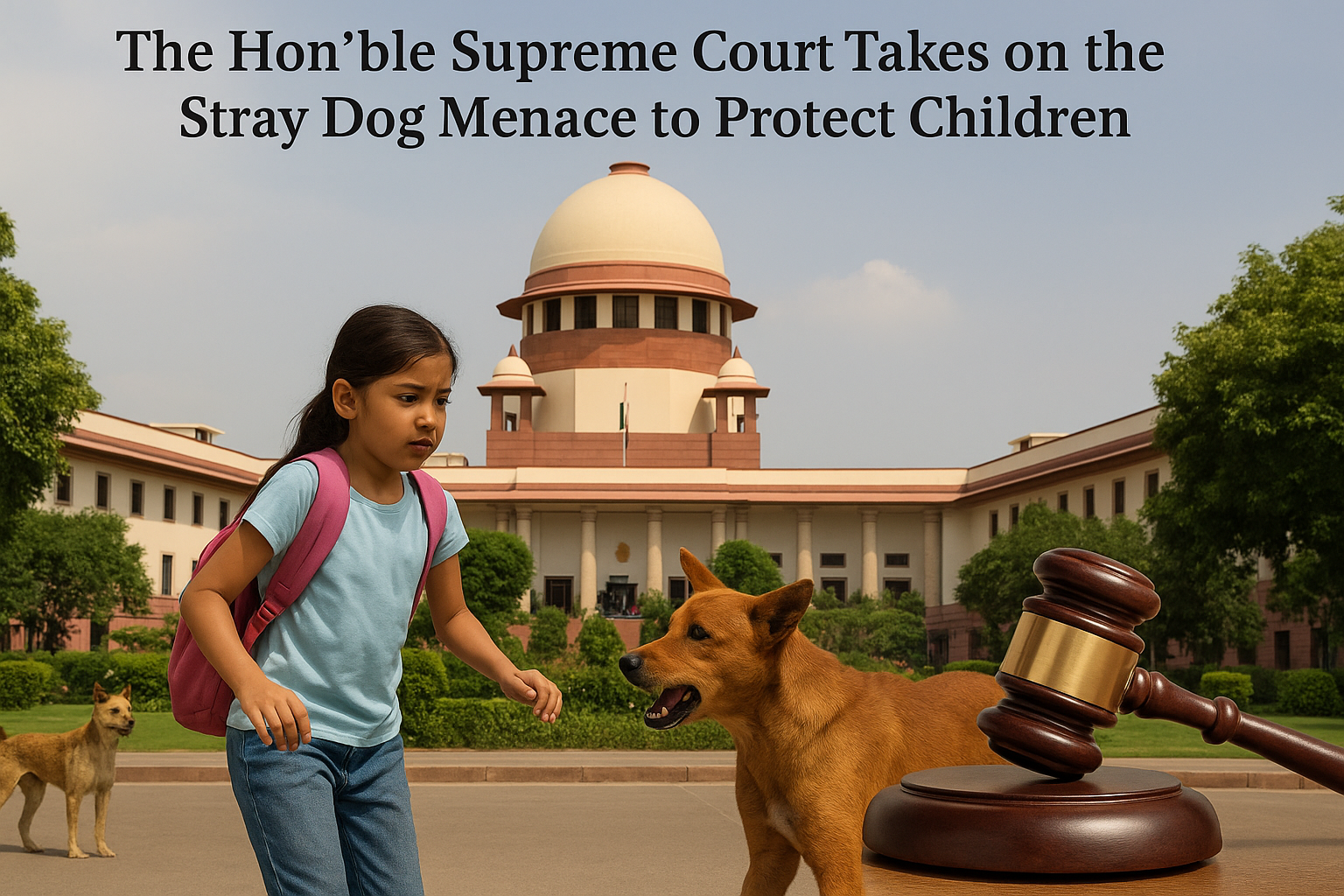
New Delhi – The Supreme Court of India has initiated a suo motu public interest litigation following an alarming newspaper report on the rising threat of stray dogs in the nation’s capital, particularly to children. The order, dated July 28, 2025, underscores a pressing urban conflict: balancing the welfare of stray animals with the fundamental right to safety for citizens, especially the most vulnerable.
The case, titled “IN RE: ‘CITY HOUNDED BY STRAYS, KIDS PAY PRICE'”, was taken up by a bench comprising Justice J.B. Pardiwala and Justice R. Mahadevan after a “very disturbing and alarming” article in the Times of India. The court was “shocked” to note the report’s statistics, which claim an average of 20,000 dog bite cases in the country, with 2,000 of those incidents occurring in Delhi daily.
The order highlights the severe human cost of this issue, pointing out that “hundreds of dog bites are being reported in the city and the areas on the outskirts, leading to rabies and ultimately young infants, children, and the aged are falling prey to this dreadful disease.”
The Heart of the Conflict: Man’s Best Friend vs. Man’s Future
This judicial intervention brings to the forefront the critical need to balance two competing interests: the humane treatment of stray dogs, often regarded as “man’s best friend,” and the protection of “man’s future,” our children. The court’s order is heavily weighted by its concern for the safety of the city’s youngest residents.
The court cited two recent, harrowing incidents involving children in Delhi:
- Chavi Sharma (6 years old): Suffered “multiple dog bites leaving deep wounds on her left leg, arm, and palm.” The court noted that residents’ prior complaints to authorities had been ignored.
- Abhishek Rai (4 years old): Was attacked by a pack of stray dogs on July 23, 2025, while returning from his Anganwadi school. The dogs “pounced at his face repeatedly” until bystanders intervened. This has led to parents becoming “wary in letting their children go out to play.”
By taking suo moto cognizance, the Supreme Court has signaled that the safety of citizens, particularly children and the elderly, is paramount and cannot be compromised. The order explicitly directs the Government of the National Capital Territory of Delhi and the Municipal Corporation of Delhi to “ensure safety of young children and aged citizens at any cost.”
Legal Steps and Future Implications
The Court has issued notices to both the Delhi Government and the Municipal Corporation of Delhi, with a returnable date of August 11, 2025. To aid in addressing this “burning issue,” the bench has appointed Advocate Gaurav Agarwal as Amicus Curiae, or friend of the court. The matter has been taken up again on August 22, 2025, where The Hon’able Supreme Court held that it is illegal to feed stray dogs on the streets and in public places.
The Court directed that stray dogs must be fed only in the dedicated feeding spaces. These dedicated feeding spaces are to be created in each Municipal ward by the authorities. Anyone found to violate this direction will be proceeded against as per the law. The Court passed this direction on the basis of reports regarding untoward incidents caused by the unregulated feeding of stray dogs. The Court stated that this practice must be eliminated so that the common citizens walking on the streets are not put to difficulties. It is still premature to ascertain how these startling directions will be received by the public, but it may safely be presumed that it will be heavily debated with people having strong opinions on opposite spectrums of this issue.
While the court acknowledged a scheme by the Delhi Government for the rehabilitation of stray dogs, it refrained from commenting on it, focusing instead on the immediate and non-negotiable need for citizen safety. This case sets the stage for a significant legal examination of municipal responsibility and animal control laws. The outcome could lead to a comprehensive framework that ensures animal welfare while guaranteeing that cities are safe for all their inhabitants, especially children.