Introduction
Civil litigation often becomes lengthy due to disputed facts, procedural stages, evidence, and prolonged trials. However, there are situations where certain facts are clearly admitted by one of the parties, leaving very little scope for actual dispute on material issues.
In such cases, the Civil Procedure Code provides courts with the power to pass a judgment on the basis of admissions without requiring a full-fledged trial. This power is contained in Order XII Rule 6 of the Code of Civil Procedure, 1908.
Order XII Rule 6 CPC is an important procedural provision that enables courts to shorten unnecessary litigation where essential facts already stand admitted. The provision is frequently invoked in civil disputes involving tenancy, possession, contractual obligations, commercial disputes, recovery matters, and other cases where material admissions can be identified from pleadings, documents, correspondence, or statements made by parties.
The provision plays a significant role in procedural efficiency because it helps in avoiding prolonged trials where no substantial dispute survives regarding essential facts.
What is Order XII Rule 6 CPC?
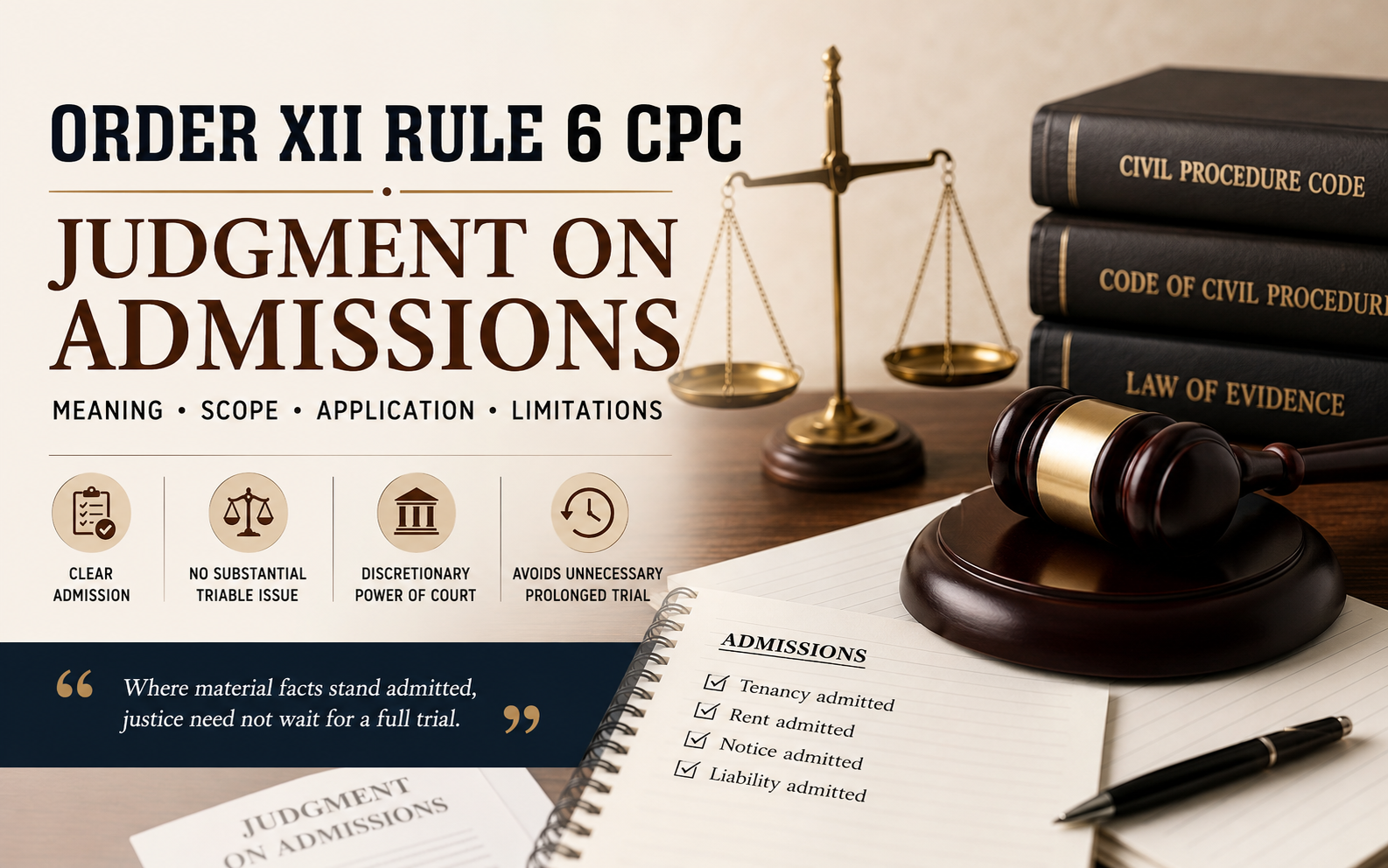
Order XII Rule 6 CPC deals with “Judgment on Admissions.”
The provision empowers courts to pass judgment at any stage of the suit where admissions made by a party are sufficiently clear and unambiguous to justify granting relief without conducting a complete trial.
The objective behind the Order XII Rule 6 provision is simple:
Where a party has already admitted material facts necessary for granting relief, the court should not unnecessarily prolong litigation merely for the sake of conducting formal evidence and trial proceedings.
The provision therefore acts as a procedural tool to:
- reduce unnecessary delay,
- minimize avoidable evidence,
- and provide quicker relief where admissions are clear.
Meaning of “Admission” Under Order XII Rule 6 CPC
An admission refers to a statement made by a party which acknowledges the existence of a fact relevant to the dispute.
Admissions may arise from:
- statements before the court,
- or other documents on record.
The admission may be:
However, not every statement amounts to a legally usable admission under Order XII Rule 6 CPC.
For the court to pass a judgment on admission, the admission must generally be:
If the alleged admission is vague, conditional, incomplete, or disputed, the court may refuse to exercise power under this provision.
Scope of Order XII Rule 6 CPC
The scope of Order XII Rule 6 CPC is wide.
The court may pass:
- partial judgment on the basis of admissions depending upon the nature of the case.
The provision may be invoked:
- or at any stage before final disposal of the suit.
Importantly, the power under Order XII Rule 6 CPC is discretionary.
This means that even where admissions exist, the court may still decide whether the circumstances justify immediate judgment or whether trial is necessary for proper adjudication.
The court examines:
- the nature of the admission,
- and overall interests of justice.
Essential Conditions for Passing Judgment on Admissions
Before granting relief under Order XII Rule 6 CPC, courts generally examine whether:
- Material Facts Are Clearly Admitted
The admission must relate to essential facts necessary for granting relief. Minor or irrelevant admissions are insufficient.
- TheAdmissionis Unequivocal
The statement must not be conditional or capable of multiple interpretations. An ambiguous statement usually does not qualify.
- No Serious Triable Issue Survives
If substantial factual disputes still require evidence, cross-examination, or detailed adjudication, courts may refuse judgment on admissions.
- TheAdmissionis Conscious and Voluntary
The admission should appear deliberate and genuine. Courts generally avoid relying upon uncertain or accidental statements.
Common Situations Where Order XII Rule 6 CPC is Invoked
Order XII Rule 6 CPC is frequently used in various civil disputes.
- Landlord-Tenant Disputes
This is one of the most common areas where the provision is invoked.
For example, where:
- rate of rent is admitted,
- and termination notice is admitted,
the landlord may seek decree for possession on admissions.
Courts frequently examine whether the essential relationship and termination stand admitted.
- Recovery Suits
In money recovery matters, admissions regarding:
- or acknowledgment of debt, may become relevant for seeking judgment on admissions.
- Commercial and Contractual Disputes
Commercial litigation often involves:
- or admitted correspondence.
In such cases, parties may invoke Order XII Rule 6 CPC to seek quicker adjudication.
- Possession Suits
Where occupation or possession is admitted and no substantial defense survives, parties may attempt to invoke the provision.
Practical Litigation Strategy Under Order XII Rule 6 CPC
In litigation practice, applications under Order XII Rule 6 CPC involve careful examination of:
Lawyers often identify admissions from:
- replies to legal notices,
- or prior statements made before courts.
The effectiveness of such applications depends significantly upon:
A properly drafted application usually:
- identifies specific admissions,
- reproduces exact relevant statements,
- explains their legal effect,
- and demonstrates why no further trial is necessary.
The argument generally revolves around the principle that in a matter where material facts stand admitted, continuation of trial becomes unnecessary.
Importance of Pleadings in Order XII Rule 6 Applications
Pleadings play a central role in applications under Order XII Rule 6 CPC.
Poorly drafted pleadings may unintentionally create admissions that later become significant during litigation. Similarly, carefully drafted pleadings may help avoid unintended admissions.
This is one reason why:
- careful factual narration,
- and procedural awareness become extremely important in civil litigation.
Admissions contained in written statements often become the foundation for applications under Order XII Rule 6 CPC.
Limitations of Order XII Rule 6 CPC
Despite its wide scope, the provision has important limitations.
- Disputed Questions of Fact
Where serious factual disputes survive, courts avoid granting decree on admissions. If evidence is necessary, trial may still be required.
- Conditional or Ambiguous Admissions
A vague statement may not amount to a valid admission. Courts usually require clarity and certainty.
- Discretionary Nature of the Provision
The court is not bound to pass judgment merely because some admission exists. The power remains discretionary.
- Complex Matters Requiring Evidence
Certain disputes involve:
- detailed factual examination,
- or mixed questions of fact and law and in such cases, courts prefer full trial.
Important Judicial Decisions
Uttam Singh Duggal & Co. Ltd. v. United Bank of India
The Supreme Court explained that the purpose of Order XII Rule 6 CPC is to enable speedy judgment where admissions are sufficient to entitle the plaintiff to relief. The Honorable Court emphasized that the provision should be used to avoid unnecessary prolongation of litigation.
Karam Kapahi v. Lal Chand Public Charitable Trust
The Supreme Court discussed the liberal and practical application of the provision where clear admissions exist. The Court recognized that the provision helps reduce unnecessary litigation and procedural delay.
Practical Examples
Example 1 – Decree Likely to be Granted
Suppose:
- and termination notice is accepted, if no substantial defense survives, the court may consider granting decree for possession under Order XII Rule 6 CPC.
Example 2 – Decree Likely to be Refused
Suppose:
- execution of agreement is challenged,
- or allegations of fraud require evidence, in such situations, trial may become necessary, and the application may fail.
Conclusion
Order XII Rule 6 CPC is an important procedural provision designed to promote efficiency in civil litigation where material facts already stand admitted. The provision reflects the principle that unnecessary trials should be avoided where substantial disputes do not survive.
At the same time, courts exercise caution while applying the provision because admissions must be:
In litigation practice, applications under Order XII Rule 6 CPC often involve:
- strategic examination of pleadings,
- and identification of legally relevant admissions.
The provision therefore holds significant practical value for civil litigators, particularly in matters involving tenancy disputes, commercial litigation, recovery suits, and possession claims.
So, understanding the scope, limitations, and practical application of Order XII Rule 6 CPC is essential for anyone seeking to understand procedural strategy in civil litigation.
In practical litigation, applications under Order XII Rule 6 CPC are generally drafted by specifically identifying the admissions relied upon and demonstrating how no substantial triable issue survives for adjudication.
While the drafting style may differ depending upon the nature of the dispute and court practice, an illustrative structure of such an application is given below for academic and practical understanding.
IN THE COURT OF __________
Civil Suit No. _____ of 20__
A … Plaintiff
Versus
B … Defendant
The Humble petition on behalf of the plaintiff abovenamed,
APPLICATION UNDER ORDER XII RULE 6 READ WITH SECTION 151 CPC FOR JUDGMENT ON ADMISSIONS
MOST RESPECTFULLY SHEWETH:
- That the present suit has been filed by the Plaintiff seeking __________.
- That in paragraph ___ of the Written Statement, the Defendant has clearly admitted __________.
- That the Defendant has further admitted __________ in paragraph ___ of the Written Statement.
- That the admissions made by the Defendant are clear, unequivocal, and sufficient for passing judgment under Order XII Rule 6 CPC.
- That no substantial triable issue survives regarding __________.
Prayer:
In view of the above facts and circumstances, it is most respectfully prayed that this Hon’ble Court may be pleased to pass judgment under Order XII Rule 6 CPC in favor of the Plaintiff and pass any other or further order Your Honor may deem fit and proper in the interest of justice.
AND FOR THIS ACT OF KINDNESS YOUR PETITIONER SHALL EVERY PRAY